Balance Scale Worksheets
Updated October 2026 · 8 free printables
Pan balance worksheets for kindergarten to 2nd grade: decide which thing is heavier, read a tipped scale, weigh toys with cubes, find the missing weight that makes a scale balance, write balance equations with block towers, compare with <, > and =, and solve shape puzzles where every scale is balanced.
Every scale is drawn in color and every page uses a different exercise, so the set builds from 'the side that goes down is heavier' all the way to early algebra. Each PDF has an answer key on page 2.
All 8 Balance Scale Worksheets, One by One
Here is a closer look at every page in this collection: what it practices, which grade it fits and a tip for each one.
-
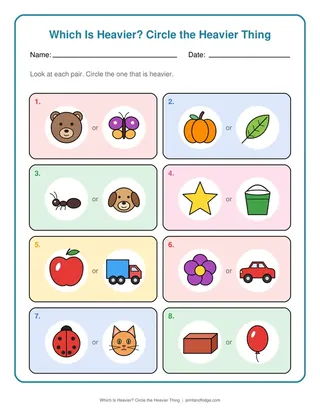
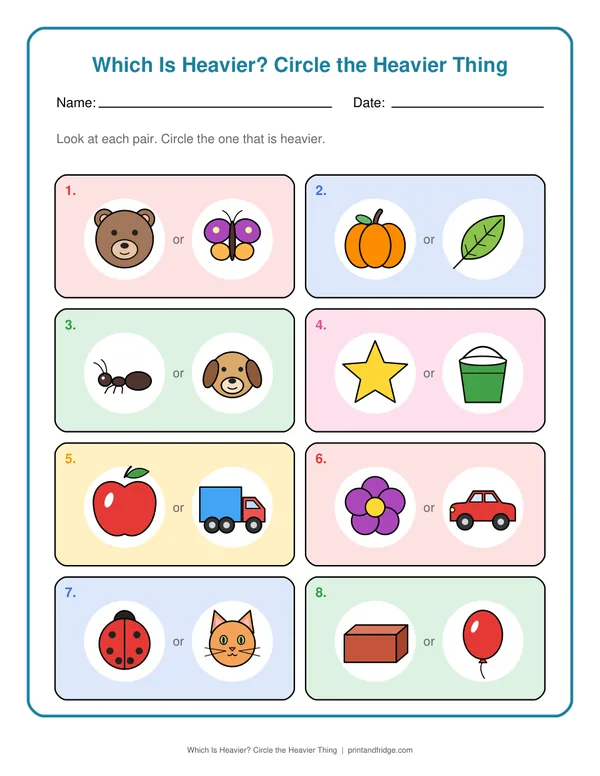
1. Which Is Heavier? Circle the Heavier Thing
A free printable which is heavier? circle the heavier thing worksheet with an answer key. Look at each pair. Circle the one that is heavier. Big pictures and only a few tasks per page make it a gentle start for kindergartners. Measure a few things at home too, like a spoon, a shoe or a toy car.
-
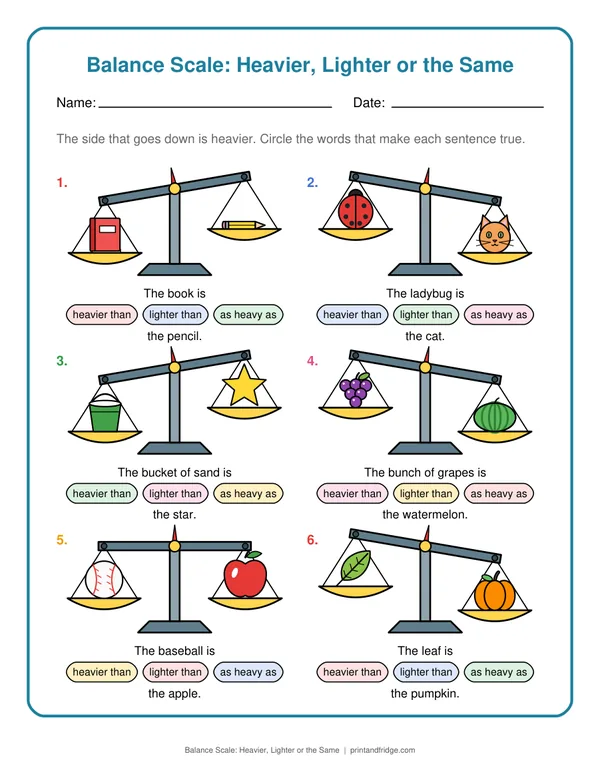
2. Balance Scale: Heavier, Lighter or the Same
A free printable balance scale: heavier, lighter or the same worksheet with an answer key. The side that goes down is heavier. Circle the words that make each sentence true. It suits ages 4 to 6, and little ones can count the pictures with a finger. Measure a few things at home too, like a spoon, a shoe or a toy car.
-
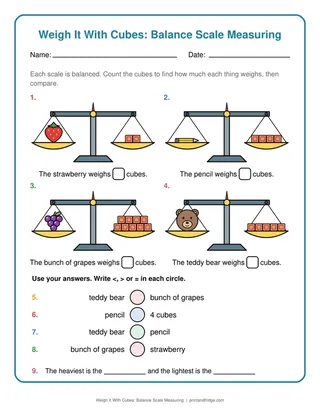
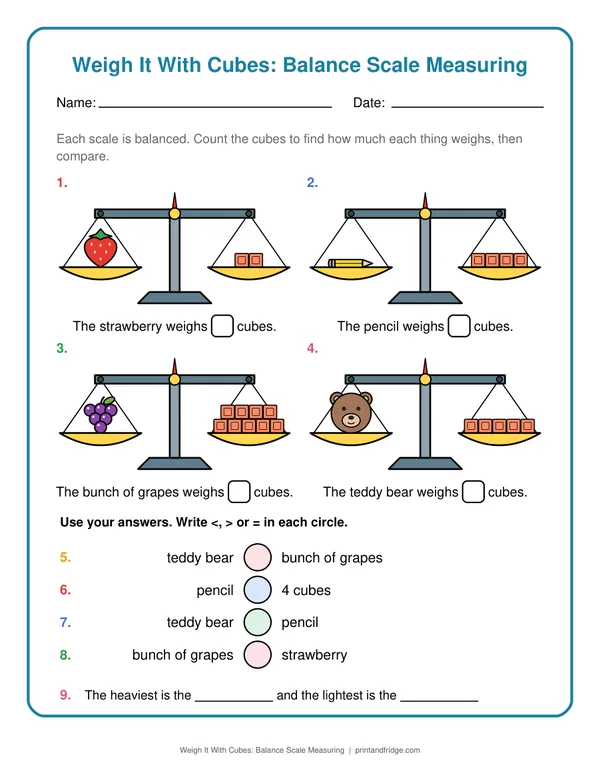
3. Weigh It With Cubes: Balance Scale Measuring
A free printable weigh it with cubes: balance scale measuring worksheet with an answer key. Each scale is balanced. Count the cubes to find how much each thing weighs, then compare. It matches first grade goals, roughly ages 6 to 7. Guess first, then measure: kids get better at estimating with every try.
-
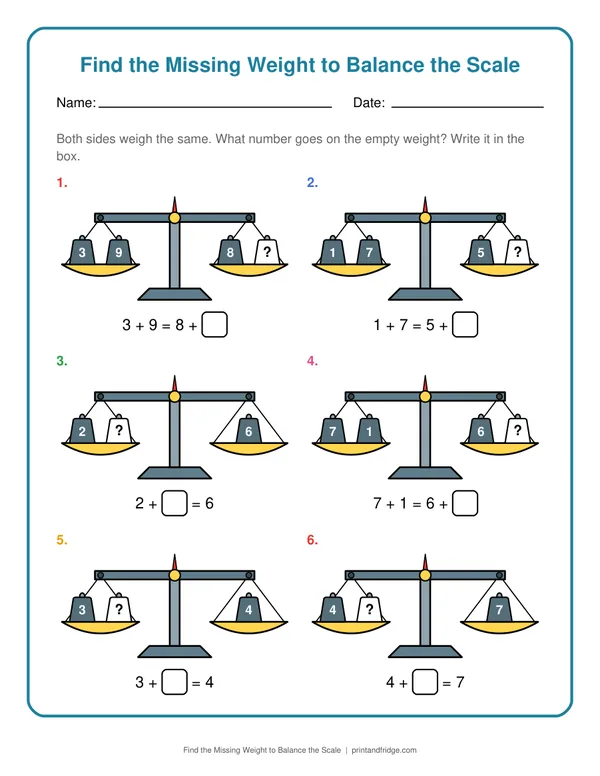
4. Find the Missing Weight to Balance the Scale
A free printable find the missing weight to balance the scale worksheet with an answer key. Both sides weigh the same. What number goes on the empty weight? Write it in the box. First graders can do it on their own once they know the strategy at the top of the page. Have your child say each fact out loud while writing the answer.
-
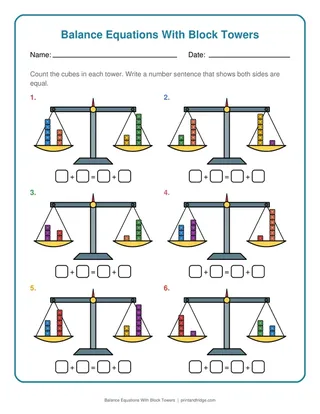
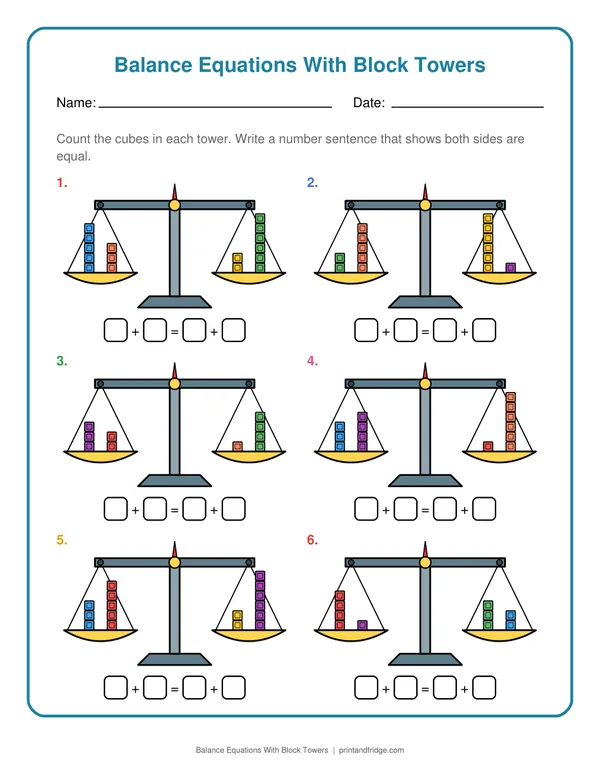
5. Balance Equations With Block Towers
A free printable balance equations with block towers worksheet with an answer key. Count the cubes in each tower. Write a number sentence that shows both sides are equal. It matches first grade goals, roughly ages 6 to 7. Use small objects like buttons or cereal to check tricky problems.
-
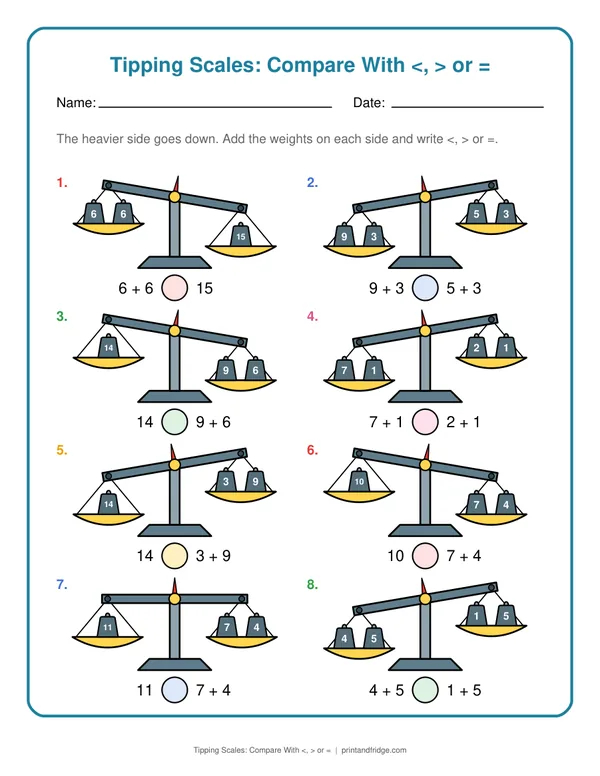
6. Tipping Scales: Compare With <, > or =
A free printable tipping scales: compare with <, > or = worksheet with an answer key. The heavier side goes down. Add the weights on each side and write <, > or =. It matches first grade goals, roughly ages 6 to 7. Remember: the open side of the sign faces the bigger number.
-
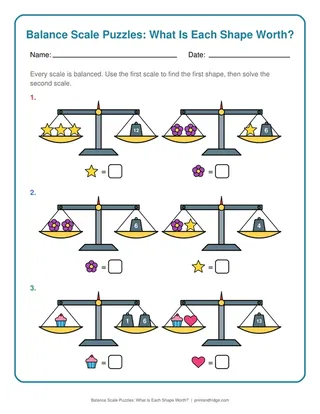
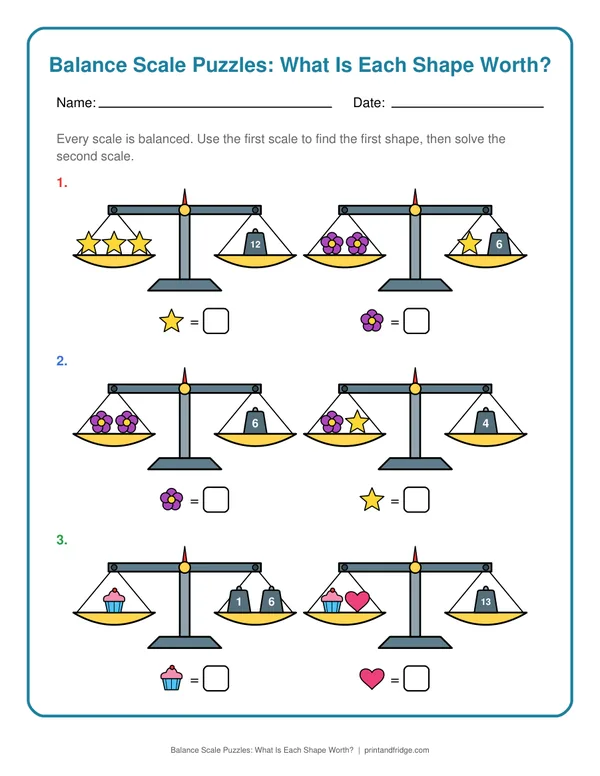
7. Balance Scale Puzzles: What Is Each Shape Worth?
A free printable balance scale puzzles: what is each shape worth? worksheet with an answer key. Every scale is balanced. Use the first scale to find the first shape, then solve the second scale. It fits second grade, around ages 7 to 8.
-
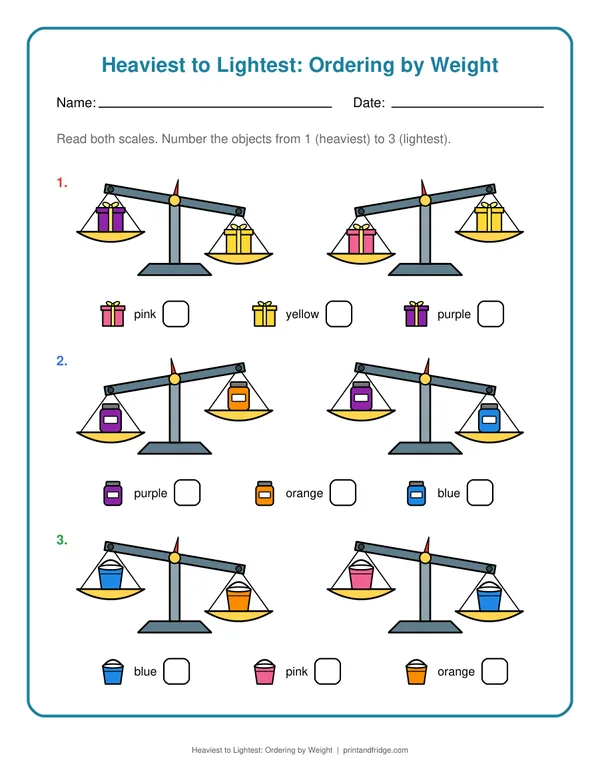
8. Heaviest to Lightest: Ordering by Weight
A free printable heaviest to lightest: ordering by weight worksheet with an answer key. Read both scales. Number the objects from 1 (heaviest) to 3 (lightest). It fits second grade, around ages 7 to 8. Measure a few things at home too, like a spoon, a shoe or a toy car.
Tips for balance scale worksheets
- Before each scale, ask: which side went down? That side is heavier, every time.
- On the missing-weight pages, add up the full side first, then ask how much the other side still needs.
- For the shape puzzles, always solve the scale with only one kind of shape first.
Fun math facts
- A pan balance compares masses directly, so it would give the same result on the Moon as on Earth.
- Balance scales are among the oldest measuring tools: Egyptian wall paintings show them about 4,000 years ago.
- An adult African elephant can weigh around 13,000 pounds, about as much as 250,000 house mice.
Fun ways to use your printables
- Build a coat-hanger balance with two paper cups and test pairs of toys before guessing on paper.
- Weigh fruit from the kitchen against wooden blocks and write each result as 'apple = 6 blocks'.
- Make your own shape puzzle: hide a number under a sticker and let your child find it from two scales.
How to print
Click Download PDF and print at 100% on US Letter or A4 paper. Page 1 is the worksheet and page 2 is the answer key, so choose “page 1” in the print dialog if you only want the practice page. Every worksheet is free for home, homeschool and classroom use, so print as many copies as you need.
Frequently asked questions
How do you read a balance scale?
The heavier side goes down and the lighter side goes up. If the beam is level, both sides weigh the same. That one rule is all a kindergartner needs for the first two worksheets.
Why use a balance scale to teach equations?
The equal sign means 'both sides are the same amount', and a level balance shows exactly that. Kids who solve 3 + ? = 7 on a scale understand that the equal sign is not just 'the answer comes next'.
What grade are balance scale worksheets for?
Comparing heavier and lighter is a kindergarten measurement skill. Missing weights and balance equations fit 1st grade, and the shape puzzles and ordering pages suit 2nd grade.
Do I need a real balance?
No, but a simple one helps: hang two paper cups from a coat hanger and compare crayons, blocks and small toys before doing the worksheets.