Symmetry Worksheets
Updated October 2026 · 12 free printables
Symmetry worksheets for kindergarten to 4th grade: color the mirror squares to finish a butterfly, a heart and an apple tree, draw the other half of a robot, a house, a rocket, an owl, a party mask and a beetle on grid paper, and draw a castle's upside-down reflection across a horizontal line.
Later pages ask kids to find every line of symmetry in shapes and capital letters, decide whether a picture is symmetrical, and color mirror mosaics and a four-way quilt block. Every picture is drawn on a grid, so the missing half can be counted out square by square, and each PDF has an answer key on page 2.
All 12 Symmetry Worksheets, One by One
Here is a closer look at every page in this collection: what it practices, which grade it fits and a tip for each one.
-
1. Finish the Butterfly: Symmetry Coloring
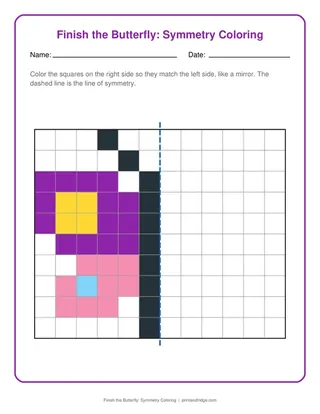
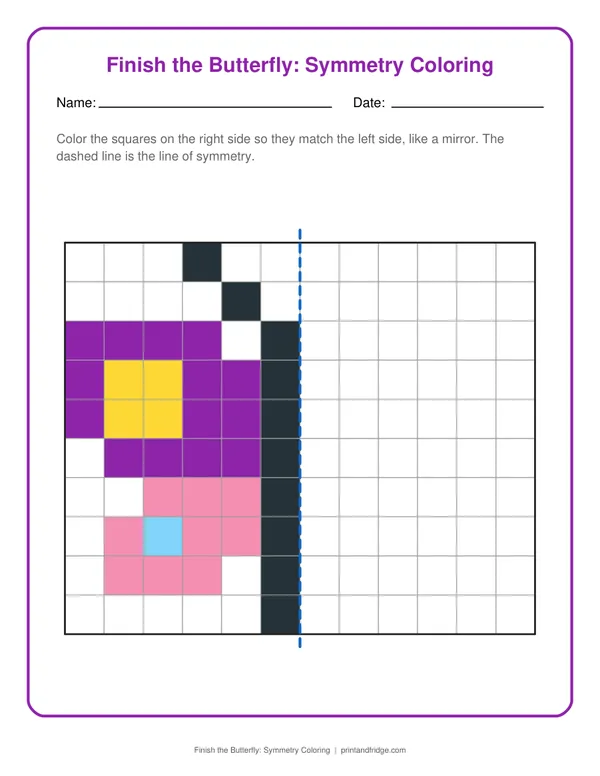
A first symmetry worksheet: the left wing of a pixel butterfly is colored square by square, and kids color the matching squares on the right of the dashed line so both wings look the same. The answer key is on page 2. Big pictures and only a few tasks per page make it a gentle start for kindergartners.
-
2. Mirror Squares: Heart and Apple Tree
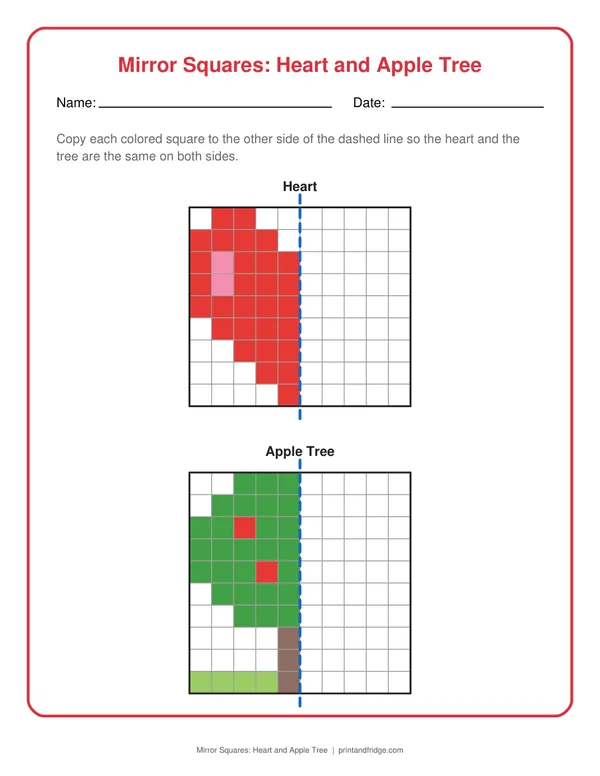
Two half pictures on big squares, a red heart and an apple tree. Kids count across from the dashed line and color the mirror squares to finish each picture. The answer key is on page 2. It suits ages 4 to 6, and little ones can count the pictures with a finger. Red, pink and purple hearts are perfect for Valentine's Day.
-
3. Is It Symmetrical? Yes or No
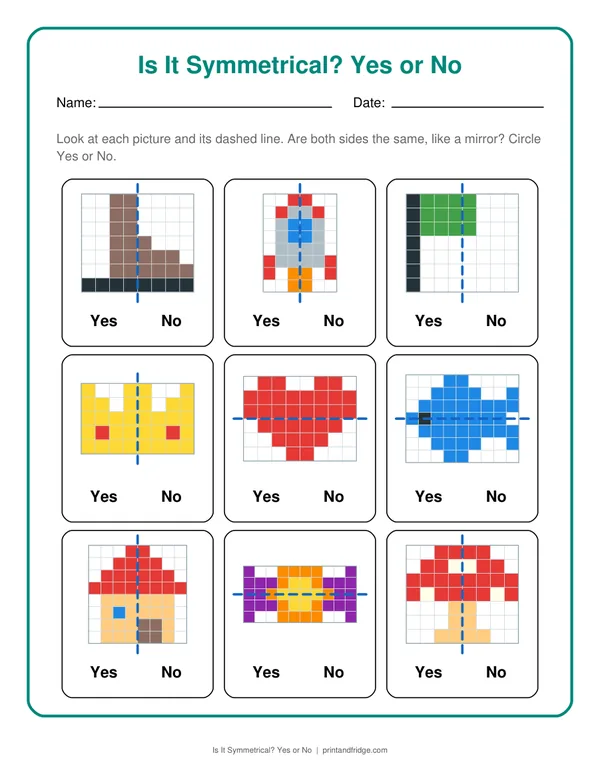
Nine little pixel pictures, each with a dashed line: a crown, a boot, a heart, a wrapped candy, a mushroom, a flag, a fish, a house and a rocket. Kids check whether both sides match and circle Yes or No. Watch out for the house door and the heart cut sideways! The answer key is on page 2. It suits ages 4 to 6, and little ones can count the pictures with a finger.
-
4. Draw the Other Half: Robot
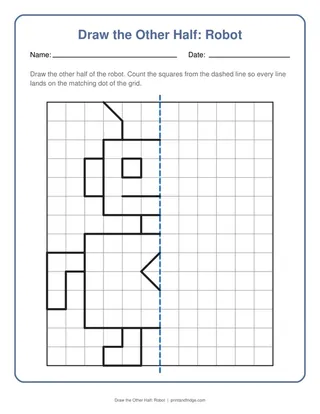
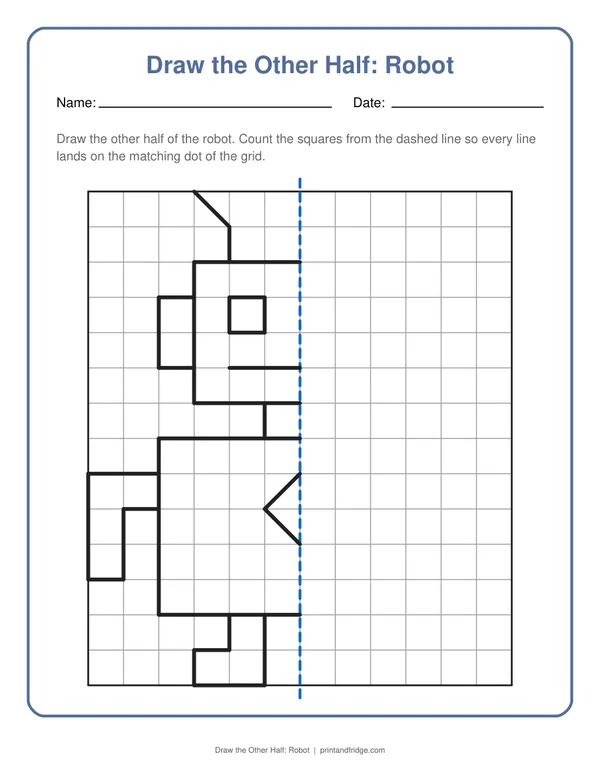
Half of a friendly robot is drawn on grid paper. Kids copy every line to the other side of the dashed line of symmetry, counting squares to find each corner: antenna, ears, eyes, arms and feet. The answer key is on page 2. It matches first grade goals, roughly ages 6 to 7.
-
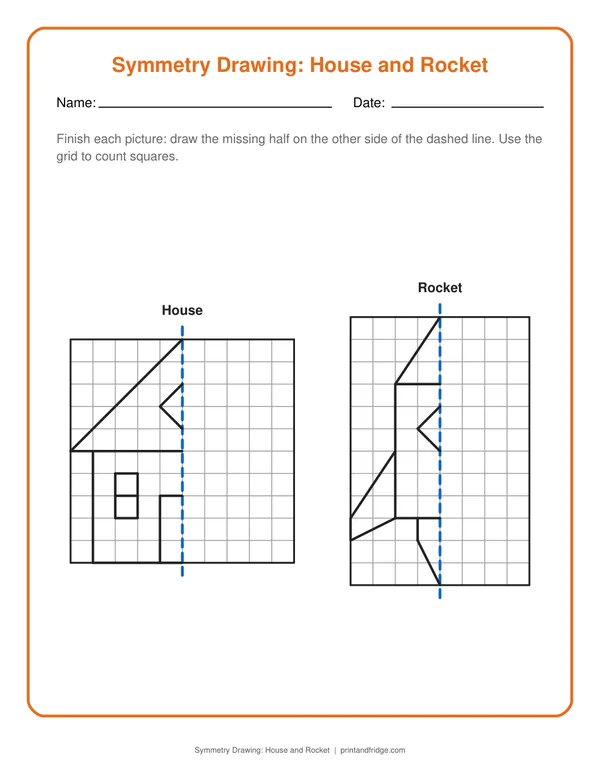
5. Symmetry Drawing: House and Rocket
Two half drawings on a grid, a house with a pointed roof and a rocket with fins. Kids mirror every line, including the slanted ones, across the dashed line of symmetry. The answer key is on page 2. First graders can do it on their own once they know the strategy at the top of the page.
-
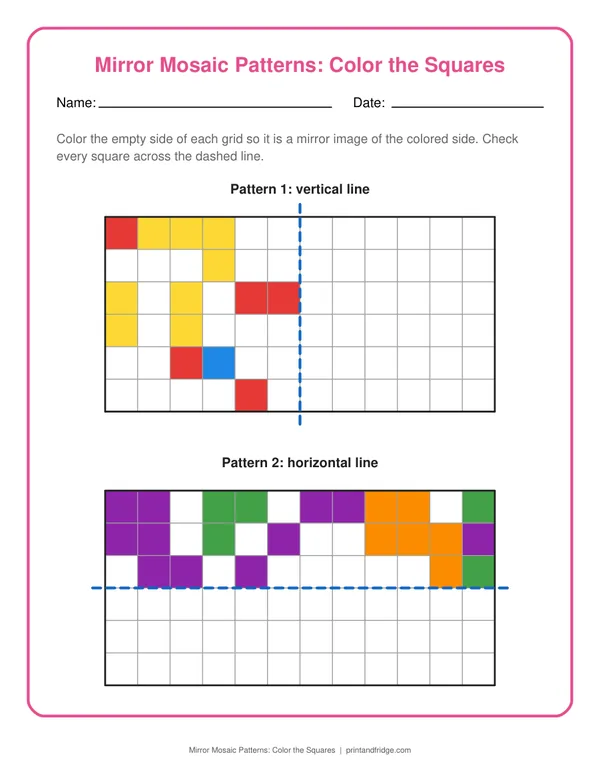
6. Mirror Mosaic Patterns: Color the Squares
Two colorful mosaic tiles on graph paper. Pattern 1 mirrors across a vertical line and Pattern 2 across a horizontal line, so kids practice both directions. The colored squares change with every printout. The answer key is on page 2. First graders can do it on their own once they know the strategy at the top of the page.
-
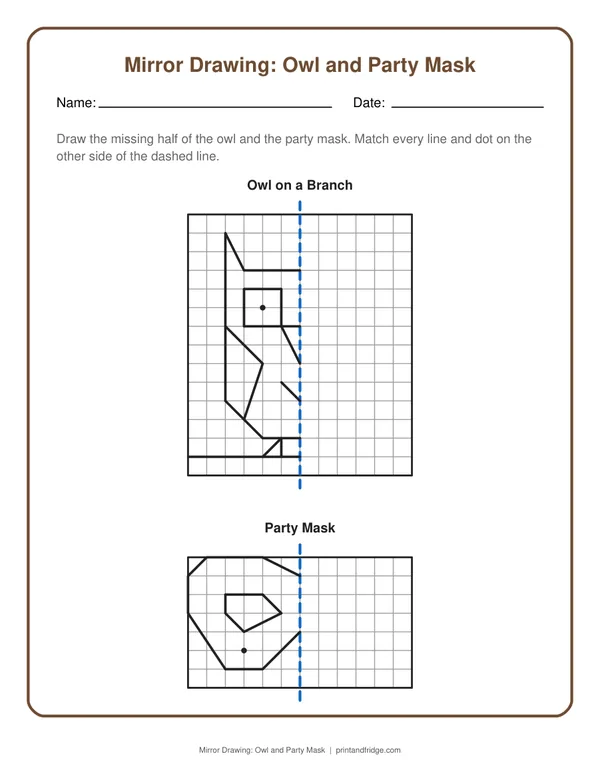
7. Mirror Drawing: Owl and Party Mask
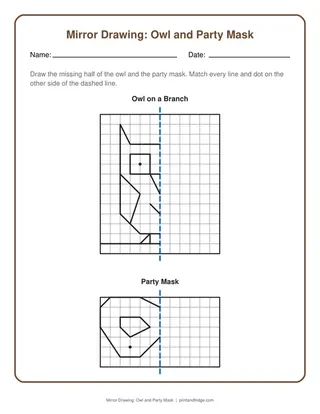
An owl sitting on a branch and a party mask, each drawn only on the left of a dashed line of symmetry. Kids mirror the slanted lines, the eye holes and the dots to finish both pictures. The answer key is on page 2. Second graders usually finish it in 10 to 15 minutes.
-
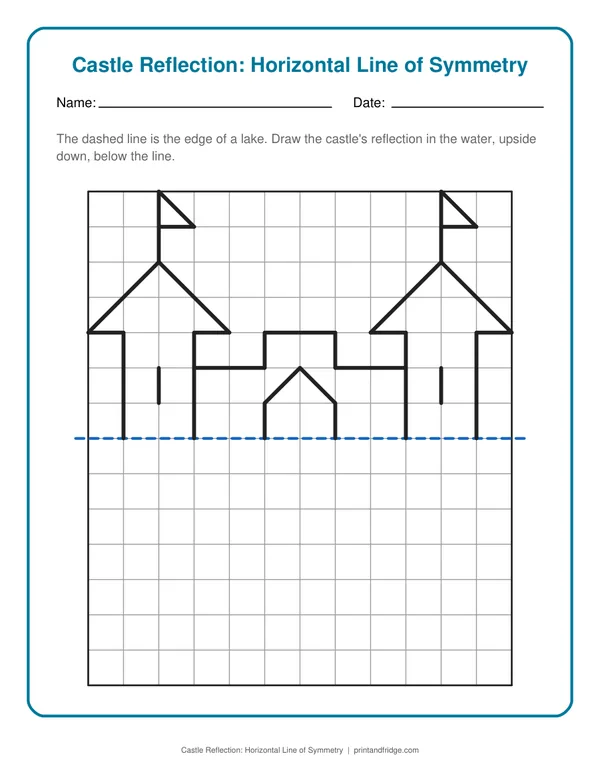
8. Castle Reflection: Horizontal Line of Symmetry
A line of symmetry does not have to stand up: here it lies flat along the water. Kids draw the upside-down reflection of a castle with two towers, flags, a gate and a wall, counting squares down from the line. The answer key is on page 2. Second graders usually finish it in 10 to 15 minutes.
-
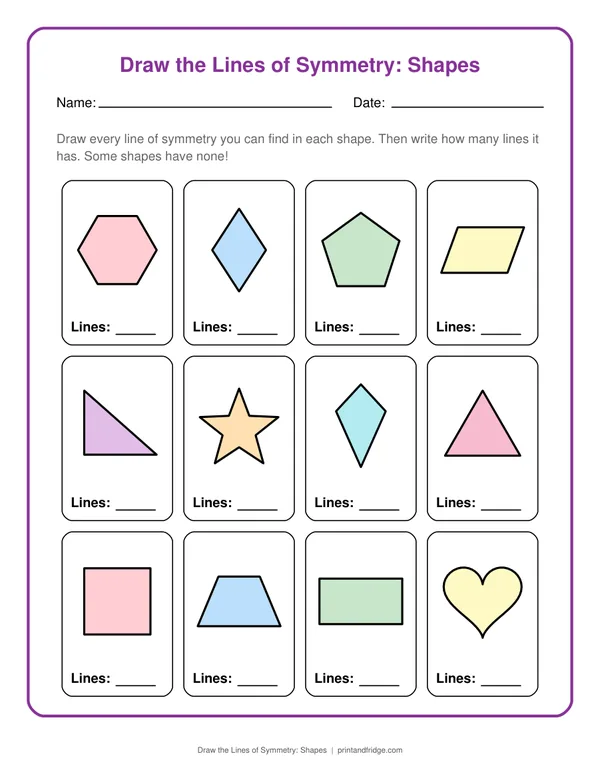
9. Draw the Lines of Symmetry: Shapes
Twelve colorful shapes, from a square and a hexagon to a heart, a star and a parallelogram. Kids draw each line of symmetry and count them; the answers range from 0 lines (parallelogram, right triangle) to 6 (hexagon). The answer key is on page 2. It fits second grade, around ages 7 to 8.
-
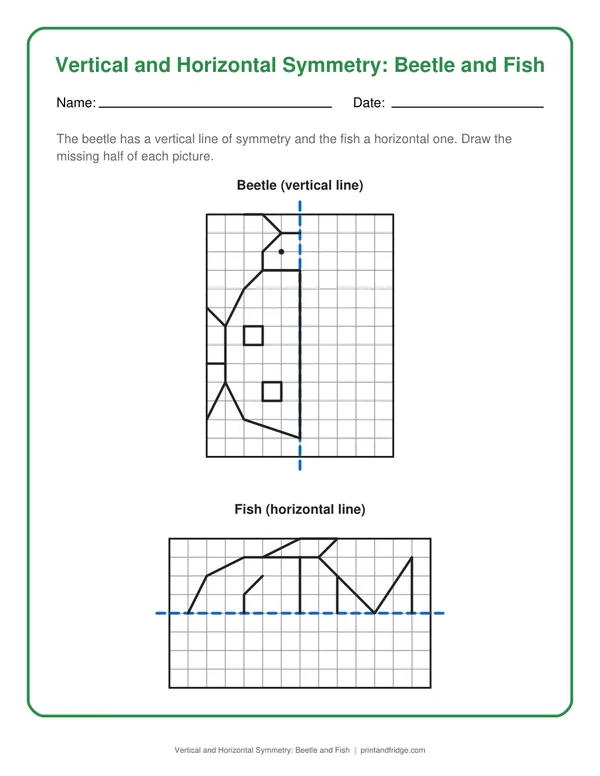
10. Vertical and Horizontal Symmetry: Beetle and Fish
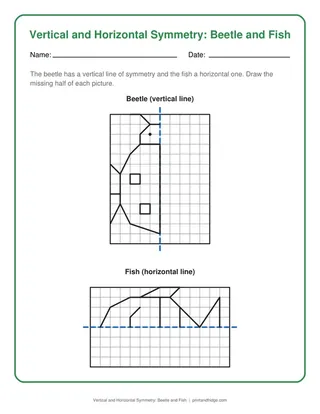
One page, two kinds of lines of symmetry: kids finish a spotted beetle across a vertical line and a striped fish across a horizontal line, mirroring legs, fins, spots and dots. The answer key is on page 2. Third graders can use it for practice, review or a quick check before a test.
-
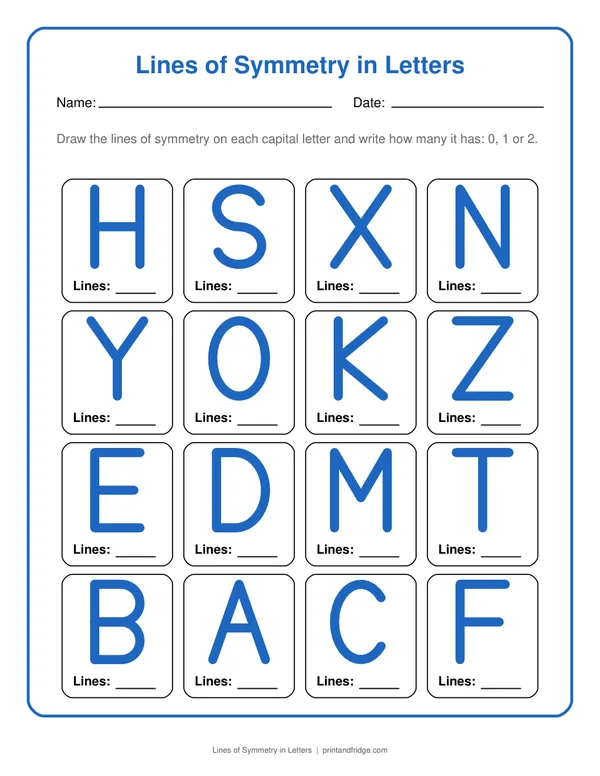
11. Lines of Symmetry in Letters
Sixteen block capital letters to test for symmetry. Some have a vertical line (Y, M, T, A), some a horizontal line, H, O and X have two, and F, N, S and Z have none. The answer key is on page 2. It is aimed at third grade, around ages 8 to 9.
-
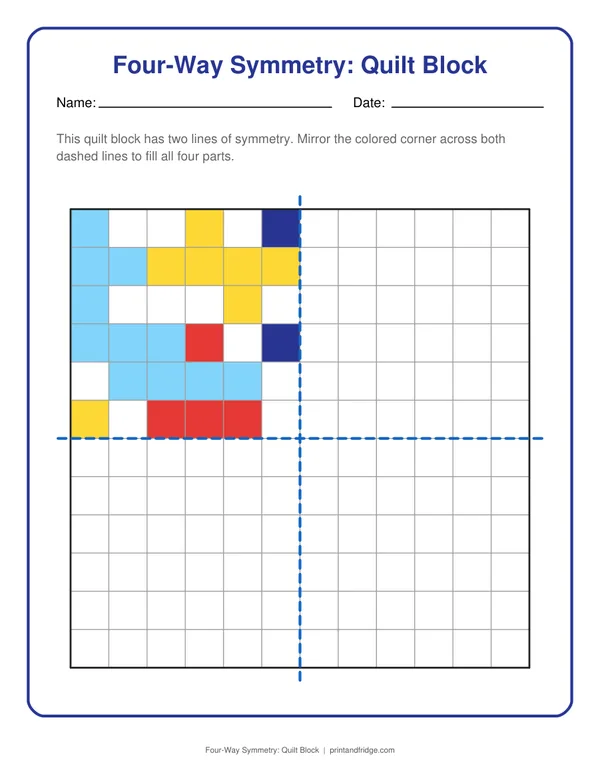
12. Four-Way Symmetry: Quilt Block
A 12 by 12 quilt block where only the top left quarter is colored. Kids reflect it across the vertical line, then across the horizontal line, to finish a block with two lines of symmetry like a real patchwork quilt. The answer key is on page 2. Expect it to take fourth graders about 15 to 20 minutes with careful work.
Tips for symmetry worksheets
- Let kids hold a small mirror on the dashed line: the reflection shows exactly what the missing half should look like.
- Count from the line, not from the edge of the grid. Every point is the same number of squares from the dashed line on both sides.
- Draw the corner dots first and connect them afterwards; it is easier to fix a dot than a long line.
Fun math facts
- A butterfly's wings, a human face and most animals have one line of symmetry that runs down the middle of the body.
- A starfish usually has five lines of symmetry, one through each arm.
- Reflections in still water are symmetrical across a horizontal line, which is why lake photos can look the same upside down.
Fun ways to use your printables
- Fold a sheet of paper, paint blobs on one half, press it shut and open it to make a symmetrical butterfly print.
- Go on a symmetry hunt at home: leaves, plates, doors, faces and letters on signs.
- Cut out paper snowflakes and count how many lines of symmetry each one has.
How to print
Click Download PDF and print at 100% on US Letter or A4 paper. Page 1 is the worksheet and page 2 is the answer key, so choose “page 1” in the print dialog if you only want the practice page. Every worksheet is free for home, homeschool and classroom use, so print as many copies as you need.
Frequently asked questions
What is a line of symmetry?
A line that splits a picture into two halves that match exactly, like a mirror image. If you folded the paper on the line, the two halves would land right on top of each other.
How do kids draw the other half on a grid?
Pick a corner of the drawing, count how many squares it is from the dashed line, and put a dot the same number of squares away on the other side. Connect the dots in the same order, and the mirror half appears.
What grade learns lines of symmetry?
Kids meet symmetry in kindergarten and 1st grade through pictures and folding. In the Common Core standards, identifying and drawing lines of symmetry is a 4th grade geometry skill (4.G.A.3), so these pages run from simple coloring to that level.
Can a shape have more than one line of symmetry?
Yes. A rectangle has 2, a square 4, a regular hexagon 6 and a circle an endless number. Some shapes, like a parallelogram or the letters F, N, S and Z, have none at all.