Ordinal Numbers Worksheets
Updated October 2026 · 5 free printables
Ordinal numbers worksheets for kindergarten and 1st grade: a car race to number from 1st to 8th, rows of pictures to color by position, matching ordinal words like 'third' to 3rd, the days of the week in order, and an animal line-up with 'who is right behind' questions.
Ordinal numbers tell position, not amount, and every page practices that idea in a different way. All five worksheets are free PDFs with answer keys.
All 5 Ordinal Numbers Worksheets, One by One
Here is a closer look at every page in this collection: what it practices, which grade it fits and a tip for each one.
-
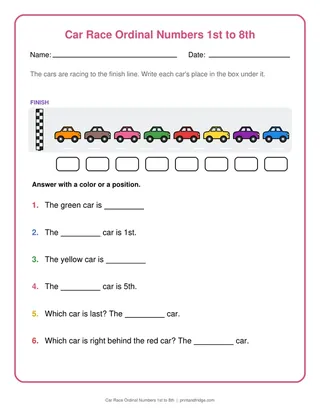
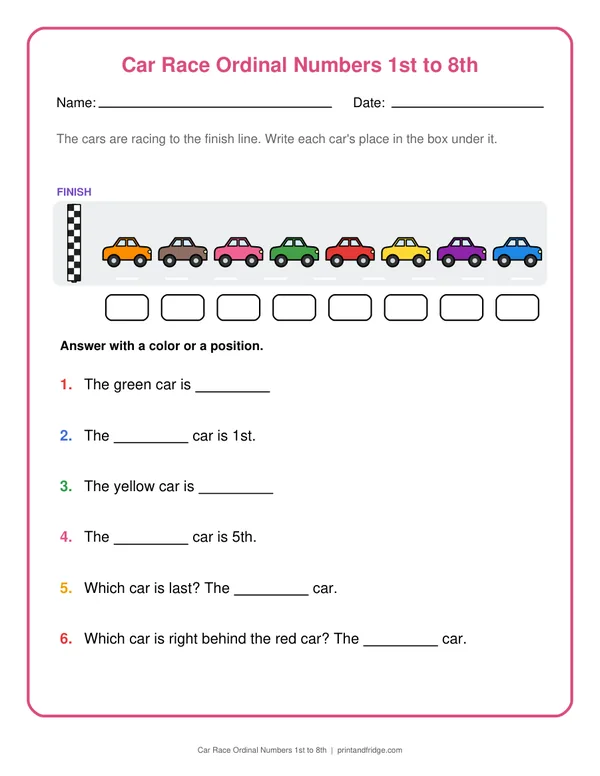
1. Car Race Ordinal Numbers 1st to 8th
A free printable car race ordinal numbers 1st to 8th worksheet with an answer key. The cars are racing to the finish line. Write each car's place in the box under it. It suits ages 4 to 6, and little ones can count the pictures with a finger.
-
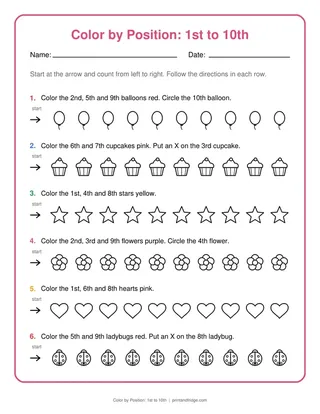
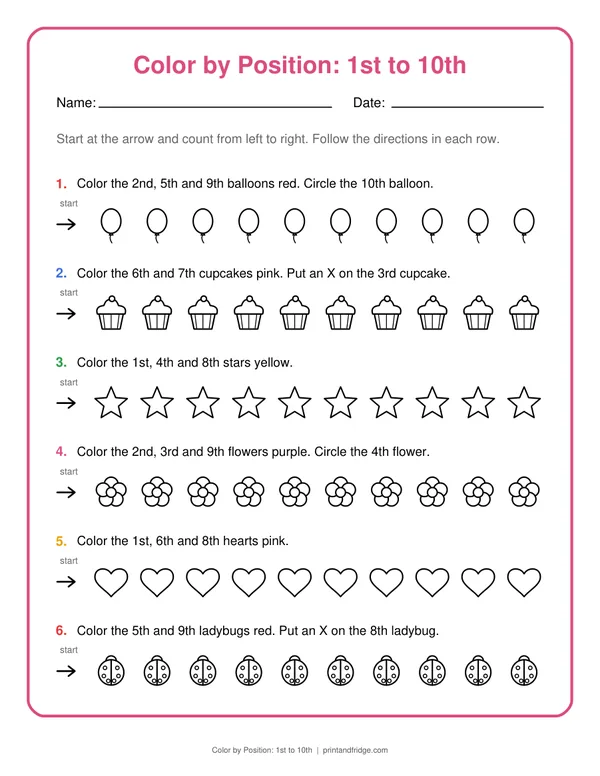
2. Color by Position: 1st to 10th
A free printable color by position: 1st to 10th worksheet with an answer key. Start at the arrow and count from left to right. Follow the directions in each row. Big pictures and only a few tasks per page make it a gentle start for kindergartners.
-
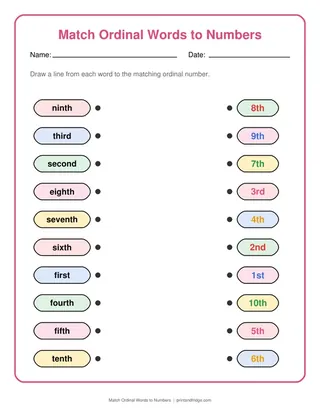
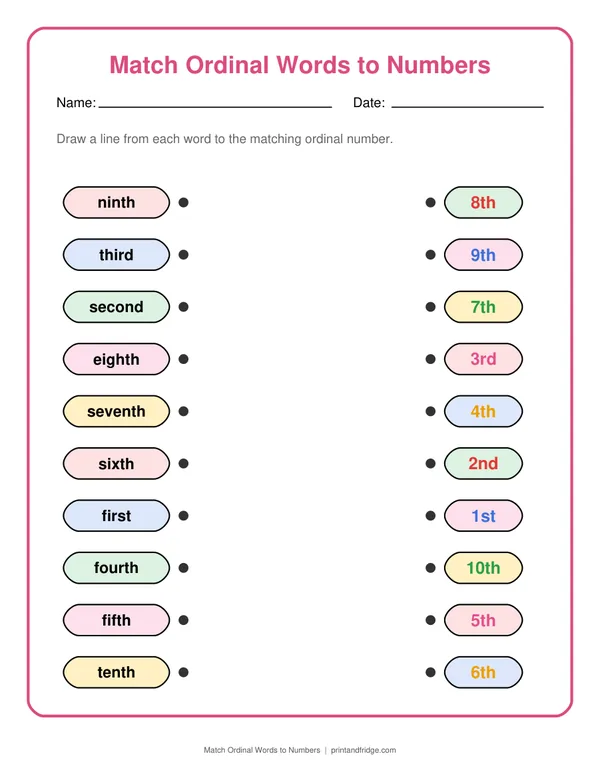
3. Match Ordinal Words to Numbers
A free printable match ordinal words to numbers worksheet with an answer key. Draw a line from each word to the matching ordinal number. It matches first grade goals, roughly ages 6 to 7.
-
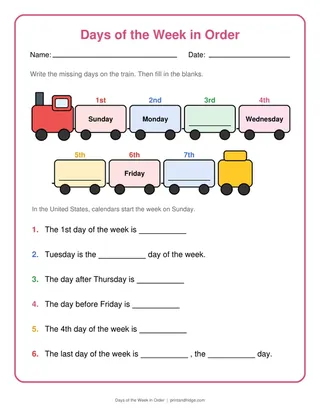
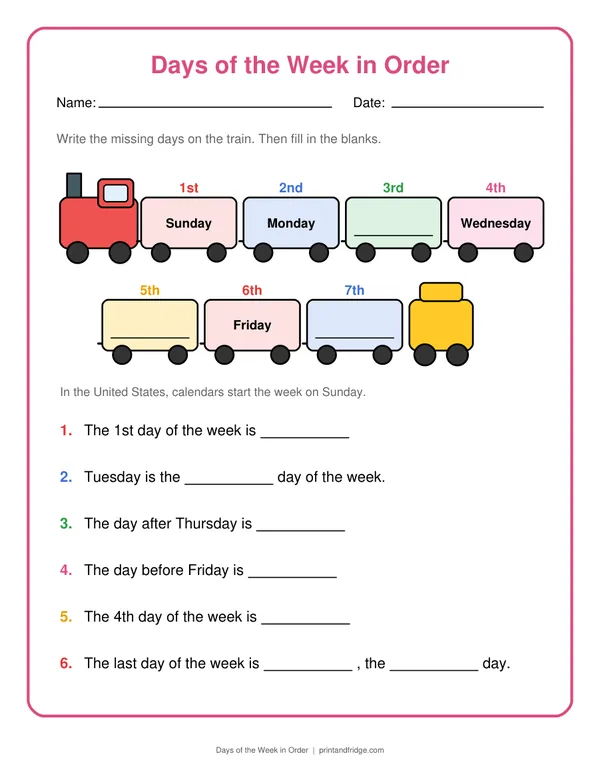
4. Days of the Week in Order
A free printable days of the week in order worksheet with an answer key. Write the missing days on the train. Then fill in the blanks. First graders can do it on their own once they know the strategy at the top of the page.
-
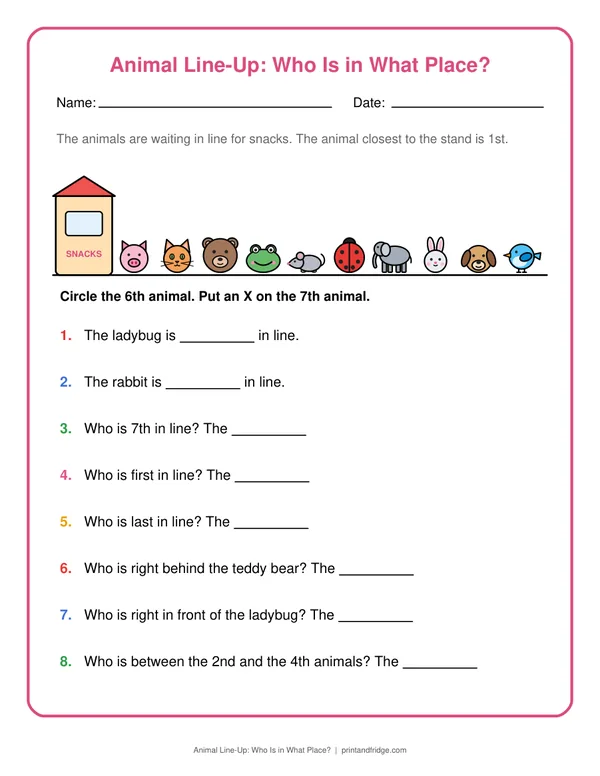
5. Animal Line-Up: Who Is in What Place?
A free printable animal line-up: who is in what place? worksheet with an answer key. The animals are waiting in line for snacks. The animal closest to the stand is 1st. It matches first grade goals, roughly ages 6 to 7.
Tips for ordinal numbers worksheets
- Point to the starting place first (the finish line, the arrow or the front of the line), then count.
- Say the ordinal word out loud while touching each picture: first, second, third.
- Remember the three special endings: 1st, 2nd and 3rd; everything after that ends in -th.
Fun math facts
- The word 'second' comes from the Latin secundus, which means 'following'.
- US calendars start the week on Sunday, while the ISO international standard starts it on Monday.
- Numbers ending in 11, 12 and 13 use -th, as in 11th, 12th and 13th, even though 1st, 2nd and 3rd do not.
Fun ways to use your printables
- Line up stuffed animals for a pretend race and announce who finished 1st, 2nd and 3rd.
- Use ordinal words for routines: first we brush teeth, second we put on pajamas, third we read.
- Tape numbered paper plates in a row and call out 'jump to the 5th plate' for a quick movement game.
How to print
Click Download PDF and print at 100% on US Letter or A4 paper. Page 1 is the worksheet and page 2 is the answer key, so choose “page 1” in the print dialog if you only want the practice page. Every worksheet is free for home, homeschool and classroom use, so print as many copies as you need.
Frequently asked questions
What are ordinal numbers?
Numbers that tell the position of something in order: first, second, third and so on, written 1st, 2nd, 3rd. Cardinal numbers (1, 2, 3) tell how many.
Why do 1st, 2nd and 3rd have different endings?
They come from the words first, second and third, which do not end in -th. From fourth on, the word and the abbreviation end in -th: 4th, 5th, 10th.
Where do you start counting positions?
From the front of the line or the starting point. On the worksheets an arrow or a finish line shows where 1st is, which is the most common mistake kids make.
What grade learns ordinal numbers?
Kindergarten covers first to tenth with pictures; 1st grade adds the written words and real-life order like the days of the week.