Free Body Parts Worksheets for Kids
Updated November 2026 · 22 free printables
Two eyes, a nose, a gap-toothed grin,
Two hands, two feet, ten small toes.
Leo drew one arm too long,
It waves hello wherever it goes.
Free printable body parts worksheets for preschool, kindergarten, first, second and third grade. There are 22 sheets, all drawn for this page with friendly kids (not clip art) and all free to print on US Letter paper, with no signup. Five are labeling pages: a boy with a word bank for kindergarten, a girl with harder words (elbow, wrist, ankle) for first grade, a no-word-bank version for second grade, a big close-up face to label, and a cut and paste page with word cards to glue on. Two cover the five senses (match the body part to the sense, and circle the part you would use), four practice reading and writing (match pictures to words, fill in the blank sentences, missing-letter spelling, word tracing), two are math (count the body parts, and word problems about fingers, toes and teeth) and three are word searches, from an 8 by 8 picture search to a hard inside-the-body puzzle.
For older kids there are two simple inside-the-body sheets: label the brain, lungs, heart, liver, stomach and intestines on a kid outline, and match each organ to its job. The rest are hands-on: draw the missing face parts, color the body by instructions, a labeled coloring page and an All About My Body page for measuring hands and feet with a friend. Every sheet with a right answer (19 of the 22) has its answer key on page 2 of the PDF; the coloring page, the tracing page and the measuring page have none because every child's work is different.


At a glance
- Pages
- 22 free printables, one PDF each
- Ages
- 3 to 9
- Levels
- Pre-K to Grade 3
- Answer keys
- 19 of the 22 pages have one on page 2
- Paper
- US Letter and A4
- Price
- free, no sign-up needed to download
All 22 Free Body Parts Worksheets for Kids, One by One
Here is a closer look at every page in this collection, with who it's best for and a coloring idea for each one.
-
1. Label the Body Parts Worksheet (Kindergarten)
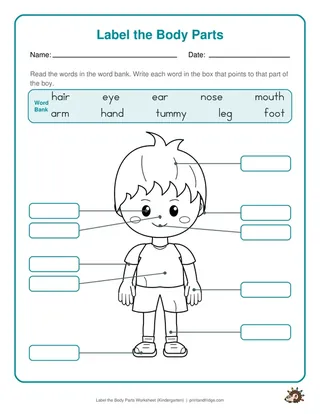
A smiling boy in a T-shirt and shorts with ten label boxes around him: hair, eye, ear, nose, mouth, arm, hand, tummy, leg and foot. Kindergartners read the word bank (printed in the ball-and-stick letters they learn to write) and copy each word into the box at the end of its line. Page 2 has every box filled in. Kindergartners can do it with the word bank and pictures, a good fit for a my-body or five senses unit.
-
2. Label the Parts of the Body: Girl (1st Grade)
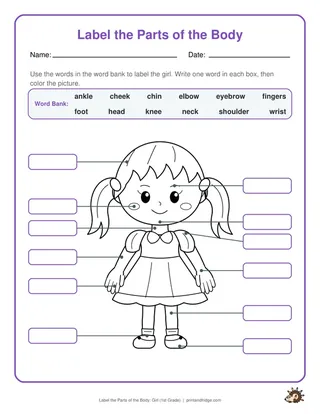
A girl with pigtails and a party dress to label with twelve words that go past the basics: head, eyebrow, cheek, chin, neck, shoulder, elbow, wrist, fingers, knee, ankle and foot. The word bank is in alphabetical order, so first graders practice finding a word as well as reading it. The answer key on page 2 shows every label. First graders, about ages 6 to 7, can read the words and write them on their own.
-
3. Label the Human Body: No Word Bank (Grade 2)
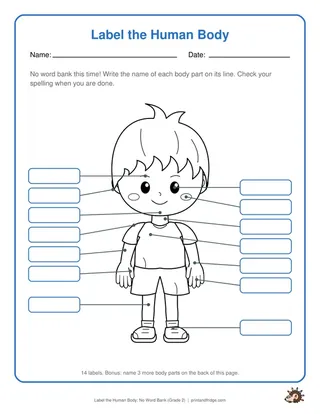
Fourteen label boxes and no word bank: second graders recall and spell eyebrow, eye, ear, cheek, chin, neck, shoulder, chest, elbow, wrist, thumb, fingers, knee and ankle on their own. A bonus line asks for three more body parts on the back. Use it as a quick science check after a body unit; the key is on page 2. Second graders use it to spell body words without help and to start looking at what is inside the body.
-
4. Label the Parts of the Face Worksheet
A big close-up of a smiling girl's face with ten parts to label: hair, forehead, eyebrow, eye, ear, nose, cheek, mouth, chin and neck. The face is drawn large so the label lines are easy to follow for small hands, and the word bank at the bottom uses handwriting letters. Answer key on page 2. Kindergartners can do it with the word bank and pictures, a good fit for a my-body or five senses unit.
-
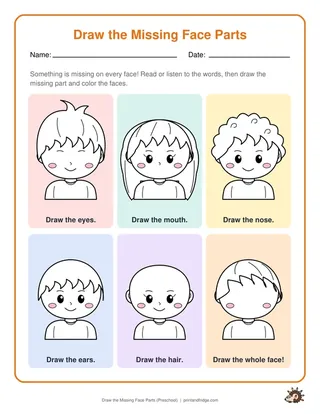
5. Draw the Missing Face Parts (Preschool)
Six friendly faces, each missing something: the eyes, the mouth, the nose, the ears, the hair, and on the last one the whole face. Preschoolers name the missing part, draw it in and color the kids. A gentle first look at the parts of the face that also works as a drawing warm-up; page 2 shows the missing parts drawn in red. It suits preschoolers, ages 3 to 5: point, name the part out loud and color, with a grown-up reading the words.
-
6. Body Parts Cut and Paste Worksheet
A girl in a dress with eight empty dashed boxes around her and eight word cards to cut out along the bottom: hair, eye, nose, mouth, arm, hand, knee and foot. Kindergartners cut, read, match and glue, so the page practices scissors skills and reading at the same time. Page 2 shows where every card goes. Kindergartners can do it with the word bank and pictures, a good fit for a my-body or five senses unit.
-
7. Match the Body Part to Its Word (Kindergarten)
Six big colored pictures on the left (an eye, an ear, a nose, a mouth, a hand and a foot) and the same six words mixed up on the right. Children say each name, find the word that starts with the right sound and draw a line between the dots. The key on page 2 shows the six lines in red. Kindergartners can do it with the word bank and pictures, a good fit for a my-body or five senses unit.
-
8. Five Senses Body Parts Matching Worksheet
Five body parts (eyes, ears, nose, tongue and hands) to connect with the five senses: see a rainbow, hear a drum, smell a flower, taste ice cream and touch a soft bunny. The sense words are printed big next to the pictures, so pre-readers can match by the picture alone. Answer key on page 2. Kindergartners can do it with the word bank and pictures, a good fit for a my-body or five senses unit.
-
9. Which Sense Would You Use? Body Parts Worksheet
Ten everyday moments, each with a picture: smell a flower, hear a bell ring, taste a sour lemon, pet a soft bunny, see the moon and more. For each one, first graders circle the body part that does the job (eye, ear, nose, tongue or hand). The key on page 2 circles the right part in red. First graders, about ages 6 to 7, can read the words and write them on their own.
-
10. Body Parts Fill in the Blank Sentences (1st Grade)
Eight short sentences about using our bodies, each missing one word: I read a book with my eyes, I catch a ball with my hands, I brush my teeth every morning and night, I put socks on my feet. A word bank and a small picture next to every sentence help first graders choose. The key on page 2 has the words filled in. First graders, about ages 6 to 7, can read the words and write them on their own.
-
11. Body Parts Spelling: Missing Letters (Grade 1)
Twelve picture cards with a body part word to finish: e_e, n_se, f__t, mo_th, t__th, th_mb, h_ir and more. Children say the picture name, listen for the middle sound and write the missing vowel (or vowel team) in the box. Words and boxes use the handwriting letters from our phonics pages; the answer key fills every box in red. First graders, about ages 6 to 7, can read the words and write them on their own.
-
12. Trace the Body Parts Words (Preschool)
Eight body part words to trace on handwriting lines: eye, ear, nose, mouth, hand, foot, arm and leg. Each word has a colored picture to say it out loud first, two dashed copies to trace with start dots, and room at the end of the line to write it once alone. No answer key is needed. It suits preschoolers, ages 3 to 5: point, name the part out loud and color, with a grown-up reading the words.
-
13. Color the Body Parts by Instructions (Kindergarten)
A boy to color by following seven short directions with a crayon picture next to each: hair brown, shirt red, shorts blue, socks yellow, shoes green, pink cheeks, and the skin in any skin color the child chooses. It practices reading color words and naming clothes and body parts. Page 2 shows a colored example. Kindergartners can do it with the word bank and pictures, a good fit for a my-body or five senses unit.
-
14. Count the Body Parts Worksheet (Kindergarten)
Eight colored pictures to count: the eyes on a face, the fingers on one hand and on two hands, the toes on two feet, the legs on two kids, the noses on three faces, three thumbs up and the arms on three kids. Children count, write the number in the box and learn that their own body is a great counting tool. Answers on page 2. Kindergartners can do it with the word bank and pictures, a good fit for a my-body or five senses unit.
-
15. Body Parts Math Word Problems (Grade 2)
Six word problems that count real body parts: hands at an art table, fingers held up and folded down, toes in the sand, a spider's legs plus three children's legs, noses and ears together, and lost baby teeth to compare. They mix addition, subtraction and repeated addition for second grade. Answer key on page 2. Second graders use it to spell body words without help and to start looking at what is inside the body. Underline the question and circle the numbers before solving.
-
16. Body Parts Picture Word Search (Kindergarten)
An 8 by 8 word search with only across and down words for beginning readers: eye, ear, nose, mouth, hand, foot, tooth and thumb. Every word in the bank has a colored picture, so children can say the word, look at its first letter and hunt for it. The answer key on page 2 marks each word with a colored band. Kindergartners can do it with the word bank and pictures, a good fit for a my-body or five senses unit.
-
17. Face and Body Word Search (Grade 2)
Twelve less common body words hidden across, down and diagonally in a 12 by 12 grid: eyebrow, forehead, cheek, lips, tongue, wrist, palm, thumb, belly, hips, ankle and heel. A good follow-up once kids know head, arm and leg, and a spelling check at the same time. Key on page 2. Second graders use it to spell body words without help and to start looking at what is inside the body.
-
18. Inside the Human Body Word Search (Grade 3)
A hard 15 by 15 word search about what is under the skin: brain, heart, lungs, stomach, liver, kidneys, intestines, skeleton, skull, ribs, spine, bones, muscles, blood, veins and skin. Words run in all eight directions, backwards too, so it suits third graders and up. The solution is on page 2. Third graders can use it for a simple human body science lesson, around ages 8 to 9.
-
19. Inside My Body: Label the Organs (Grade 2)
A friendly kid outline with six organs drawn inside in color: brain, lungs, heart, liver, stomach and intestines. Second graders use the word bank to label each one and see where it sits in the body (the heart between the lungs, the stomach under them). Nothing gory, just simple shapes. Answer key on page 2. Second graders use it to spell body words without help and to start looking at what is inside the body.
-
20. What Do My Organs Do? Matching Worksheet (Grade 3)
Six body parts inside us, each with a colored picture: brain, heart, lungs, stomach, intestines and bones. Third graders read six job descriptions (pumps blood all around the body, breathe air in and out, hold the body up) and connect each organ to its job. The key on page 2 draws the lines in red. Third graders can use it for a simple human body science lesson, around ages 8 to 9.
-
21. Body Parts Coloring Page with Labels
A boy and a girl to color, with ten body parts labeled in big hollow letters that children can color too: hair, eye, mouth, hand, knee and foot on the boy, ear, arm, leg and shoe on the girl. A box at the bottom invites kids to draw themselves. Made for preschool, in black and white for any printer. It suits preschoolers, ages 3 to 5: point, name the part out loud and color, with a grown-up reading the words.
-
22. All About My Body: Measure and Compare (Grade 1)
A hands-on page for first graders: trace your hand, measure your hand, foot and arm in cubes, write how tall you are and how many baby teeth you have lost, then fill in a table that compares you with a friend. Every child's answers are different, so there is no answer key; it pairs well with a measurement unit. First graders, about ages 6 to 7, can read the words and write them on their own. Guess first, then measure: kids get better at estimating with every try.
Tips for coloring Free Body Parts Worksheets for Kids
- Before any worksheet, play "touch your...": call out a body part and have kids touch it on themselves. The labels stick much faster after the body has done it.
- On the labeling pages, read the word bank aloud together first and cross each word out once it is used.
- For the cut and paste page, cut the word cards first and lay them on the table; younger kids can glue them while you read.
- Pair the measuring page with real objects: connecting cubes, paper clips or LEGO bricks all work as units.
- Laminate the labeled coloring page and use it as a reference poster on the classroom wall.
Fun facts about Free Body Parts Worksheets for Kids
- An adult body has 206 bones, but a baby is born with nearly 300; many of them grow together as the child grows.
- The skin is the largest organ of the body.
- Your tongue has thousands of taste buds, and they are replaced about every two weeks.
- A child's heart beats about 70 to 110 times a minute at rest, a little faster than an adult's.
- Fingerprints are fully formed before a baby is born, and no two people have the same ones.
Fun ways to use your printables
- Trace around a child on big paper, cut out the outline and label it with sticky notes together.
- Sing "Head, Shoulders, Knees and Toes" faster and faster, then label those four parts on the worksheet.
- Make a five senses walk: list one thing you see, hear, smell, touch and (safely) taste outside.
- Compare handprints with family members and line them up from smallest to biggest.
How to print
Click Download PDF on any page and print it at 100% on US Letter or A4 paper. Use regular printer paper for crayons and pencils, or cardstock for markers and paint. Every page here is free for home, classroom and party use, so feel free to print as many copies as you need.
Frequently asked questions
Which body parts worksheet should I use for preschool?
Start with the three preschool pages: Draw the Missing Face Parts (six faces, each missing the eyes, mouth, nose, ears, hair or the whole face), Trace the Body Parts Words (eye, ear, nose, mouth, hand, foot, arm and leg with pictures) and the Body Parts Coloring Page with big hollow labels. Then move on to the kindergarten labeling page with a word bank and the picture word search.
Do the body parts worksheets come with answer keys?
Yes. 19 of the 22 sheets have an answer key on page 2 of the same PDF: labels written in red, matching lines drawn in, word searches with every word marked, and a colored example for the color-by-instructions page. Only the tracing page, the coloring page and the measuring page have no key.
Are there five senses worksheets in this set?
Two sheets are about the five senses. The kindergarten one matches eyes, ears, nose, tongue and hands to see, hear, smell, taste and touch with a picture for each; the first grade one lists ten everyday moments (smell cookies baking, hear a bell ring, pet a soft bunny) and kids circle the body part they would use. The fill in the blank page also practices sense sentences such as "I hear the bell with my ears."
Do these work for ESL and English language learners?
Yes. Body parts are one of the first vocabulary topics in ESL and ELL classes, and most pages lean on pictures: the picture word search, the picture-to-word match, the labeling pages with a word bank and the spelling cards all show what the word means. Start with labeling plus matching, then use the fill in the blank sentences once students read short sentences.
Can I print them on A4 paper?
The PDFs are US Letter (8.5 by 11 inches). On A4 choose "fit to page" (or "shrink to printable area") in the print dialog; nothing important sits near the edges, so the sheets print fine. They also print well in black and white, although the pictures on the matching and senses pages are in color.
Can teachers use these in the classroom?
Yes, print a class set of any sheet for a science unit, a my body or all about me theme, centers or homework. A simple week: label the body on day one, the face on day two, the five senses on day three, spelling or the word search on day four and the measuring page with a partner on day five. Please do not resell the sheets or upload them to another site.
Is the inside of the body sheet too scary for young kids?
No. The organs are simple, colorful shapes (a pink brain, two lungs, a red heart, an orange stomach) inside a smiling kid outline, with no blood or realistic detail. It is labeled grade 2, and the matching page about what each organ does is grade 3.
Are the body parts worksheets really free?
Yes. Every sheet is a free PDF to download and print, with no signup and no email needed for single sheets.