4th and 5th Grade Reading Comprehension Worksheets
Updated November 2026 · 10 free printables
Free printable reading comprehension worksheets for 4th and 5th grade: ten original passages of about 180 to 230 words, each with a picture, three to five questions and an answer key on page 2.
By signing up you agree to our privacy policy and to occasional emails with new printables. Unsubscribe any time.
Thank you! Your PDF is downloading. If it did not start, tap here to download it.


About these printables
Six are nonfiction, about the boy who invented the Popsicle, how volcanoes form, the monarch butterfly migration, life on the International Space Station, Gutenberg's printing press and how hurricanes form; four are stories, from a Christmas Eve blizzard to a Thanksgiving parade balloon and a girl who learns what her mom does as a 911 dispatcher.
The questions practice what upper elementary tests ask for: the main idea, the meaning of a word in context, the order of events, vocabulary matching, and short written answers that use details from the text.
At a glance
- Pages
- 10 free printables, one PDF each
- Ages
- 9 to 11
- Levels
- Grade 4, Grade 5
- Answer keys
- on page 2 of every PDF
- Paper
- US Letter and A4
- Complete pack
- all 10 pages in one PDF, free with an email sign-up
- Price
- free; every single page downloads with no sign-up
All 10 4th and 5th Grade Reading Comprehension Worksheets, One by One
Here is a closer look at every page in this collection: what it practices, which grade it fits and a tip for each one.
-
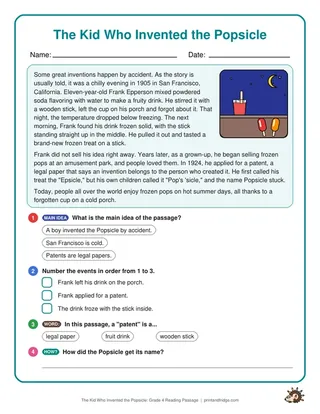
1. The Kid Who Invented the Popsicle: Grade 4 Reading Passage
A fourth grade nonfiction passage about Frank Epperson, the 11-year-old whose forgotten drink froze into the first Popsicle. A free printable 4th grade nonfiction passage (182 words) with multiple-choice main idea/vocabulary/how questions, events to number in order and a short written answer. Answer key on page 2. It is written for fourth grade readers, around ages 9 to 10.
-
2. How Volcanoes Form: Grade 4 Reading Passage
A fourth grade earth science passage about magma, moving plates, the Ring of Fire, Mount St. Helens and how volcanoes build new land. A free printable 4th grade nonfiction passage (186 words) with multiple-choice what/why questions, true-or-false sentences, a vocabulary match and a short written answer. Answer key on page 2. Fourth graders can read it on their own and back up each answer with a sentence from the text.
-
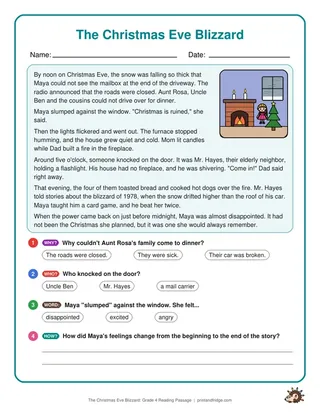
3. The Christmas Eve Blizzard: Grade 4 Reading Passage
A blizzard closes the roads and knocks out the power on Christmas Eve, and Maya's family shares their fire with an elderly neighbor. A free printable 4th grade short story (192 words) with multiple-choice why/who/vocabulary/how questions and a short written answer. Answer key on page 2. Fourth graders can read it on their own and back up each answer with a sentence from the text. Red, green and gold make a classic Christmas palette.
-
4. The Great Monarch Migration: Grade 4 Reading Passage
A fourth grade science passage about the monarch butterflies that fly up to 3,000 miles to Mexico, the long-lived generation that makes the trip and milkweed. A free printable 4th grade nonfiction passage (190 words) with multiple-choice where/what/how questions, true-or-false sentences and a short written answer. Answer key on page 2. It is written for fourth grade readers, around ages 9 to 10.
-
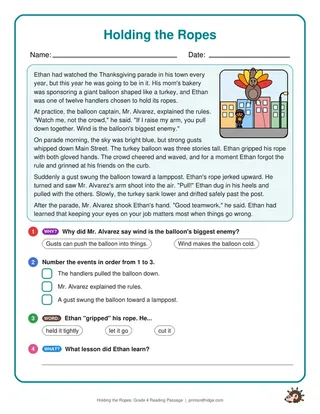
5. Holding the Ropes: Grade 4 Reading Passage
At the town's Thanksgiving parade, Ethan helps steer a giant turkey balloon and learns why the handlers must watch their captain. A free printable 4th grade short story (202 words) with multiple-choice why/vocabulary/what questions, events to number in order and a short written answer. Answer key on page 2. It is written for fourth grade readers, around ages 9 to 10.
-
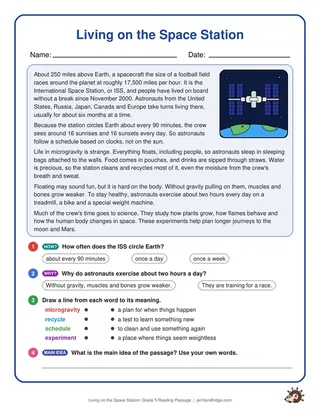
6. Living on the Space Station: Grade 5 Reading Passage
A fifth grade nonfiction passage about life on the International Space Station: 16 sunrises a day, floating meals, recycled water, daily exercise and experiments. A free printable 5th grade nonfiction passage (223 words) with multiple-choice how/why/main idea questions, a vocabulary match and a short written answer. Answer key on page 2. Fifth graders can use it to practice main idea, vocabulary in context and answers supported by the text.
-
7. Gutenberg's Printing Press: Grade 5 Reading Passage
A fifth grade history passage about books copied by hand, Johannes Gutenberg's movable type, the Gutenberg Bible and how printing changed the world. A free printable 5th grade nonfiction passage (220 words) with multiple-choice who/vocabulary/how questions, events to number in order and a short written answer. Answer key on page 2. Fifth graders can use it to practice main idea, vocabulary in context and answers supported by the text.
-
8. Grandpa's Weather Journal: Grade 5 Reading Passage
Amara finds forty years of her grandfather's weather notes, spots a pattern he missed and turns it into a science fair project. A free printable 5th grade short story (213 words) with multiple-choice what/vocabulary/why questions and a short written answer. Answer key on page 2. It is aimed at fifth grade readers, around ages 10 to 11.
-
9. How Hurricanes Form: Grade 5 Reading Passage
A fifth grade weather passage about how hurricanes grow over warm ocean water, the calm eye, the 1 to 5 categories and storm surge. A free printable 5th grade nonfiction passage (228 words) with multiple-choice what/how questions, a vocabulary match and a short written answer. Answer key on page 2. It is aimed at fifth grade readers, around ages 10 to 11.
-
10. The Voice on the Phone: Grade 5 Reading Passage
Zoe thinks her mom's job as a 911 dispatcher is boring, until a visit to the emergency center changes her mind before Career Day. A free printable 5th grade short story (225 words) with multiple-choice what/why/vocabulary/how questions and a short written answer. Answer key on page 2. Fifth graders can use it to practice main idea, vocabulary in context and answers supported by the text.
Tips for parents and teachers
- Ask your student to read the questions first, then read the passage with a pencil and mark the answers as they appear.
- For main idea questions, cover the choices and say the main idea in one sentence first; then pick the closest choice.
- When a written answer asks why or how, start with "because" or "by" and add one detail from the text.
Did you know?
- Monarch butterflies that hatch at the end of summer can live about eight months, while most monarchs live two to six weeks.
- Astronauts on the International Space Station see about 16 sunrises and 16 sunsets every day.
- A storm needs winds of at least 74 miles per hour to be called a hurricane.
Fun ways to use your printables
- After the printing press passage, make a stamp from a potato or an eraser and print your initials.
- Pair the weather journal story with a week of your own weather notes: temperature, clouds and rain.
- Turn a nonfiction passage into a five-fact poster with a title, a picture and a new word box.
How to print
Click Download PDF and print at 100% on US Letter or A4 paper. Page 1 is the worksheet and page 2 is the answer key, so choose “page 1” in the print dialog if you only want the practice page. Every worksheet is free for home, homeschool and classroom use, so print as many copies as you need.
Frequently asked questions
How hard are these passages?
They are written for students around ages 9 to 11. Sentences are longer, the topics include history and earth science, and new words such as magma, microgravity or movable type are explained in the text so students can work out their meaning.
How long does one worksheet take?
Most 4th and 5th graders need 15 to 20 minutes: about 5 minutes to read the passage twice and 10 to 15 minutes for the questions.
How do I check written answers?
Page 2 shows a sample answer for every written question. Accept any answer in the student's own words that matches the text and uses a detail from it.
Are the facts accurate?
Yes. Dates, numbers and science facts, such as the 1980 Mount St. Helens eruption, the 74 mph hurricane threshold and the ISS orbit of about 90 minutes, were checked against standard references such as NASA, NOAA and the USGS.