Free Verbs Worksheets: Action Verbs and Past Tense
Updated November 2026 · 7 free printables
Seven printable verbs worksheets for grades 1 to 3. The first grade pages start with action: nine animals and nine verbs (the frog croaks, the bee buzzes, the cow moos) and ten simple sentences where children underline the action word, each with a picture.


About these printables
Second grade practices the past tense with -ed (Yesterday I walked to school), the most common irregular verbs (go and went, see and saw, swim and swam) and the linking verbs is, are, was and were. Third grade adds the spelling rules for -ed (stop to stopped, smile to smiled, carry to carried) and ten sentences with irregular past tense verbs such as wrote, drank, built and slept. Answer keys on page 2.
At a glance
- Pages
- 7 free printables, one PDF each
- Ages
- 6 to 9
- Levels
- Grade 1, Grade 2, Grade 3
- Answer keys
- on page 2 of every PDF
- Paper
- US Letter and A4
- Price
- free, no sign-up needed to download
All 7 Free Verbs Worksheets: Action Verbs and Past Tense, One by One
Here is a closer look at every page in this collection: what it practices, which grade it fits and a tip for each one.
-
1. Action Verbs: What Does the Animal Do?
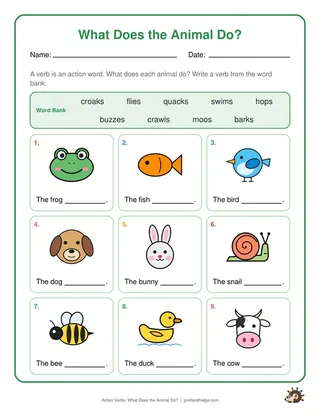
Nine animal pictures and nine action verbs: the frog croaks, the fish swims, the bird flies, the bunny hops, the snail crawls, the bee buzzes, the duck quacks, the cow moos. Children write the verb that finishes each sentence. Answer key on page 2. It is a first grade grammar sheet, ages 6 to 7, with pictures or a word bank so early readers can work on their own.
-
2. Find the Verb: Underline the Action Word
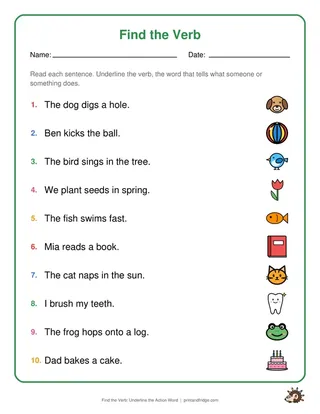
Ten simple sentences, one action verb in each, with a picture to help: The dog digs a hole, Ben kicks the ball, We plant seeds in spring, The frog hops onto a log. Children underline the verb; the key on page 2 underlines it in red. It is a first grade grammar sheet, ages 6 to 7, with pictures or a word bank so early readers can work on their own.
-
3. Past Tense Verbs: Add -ed Worksheet
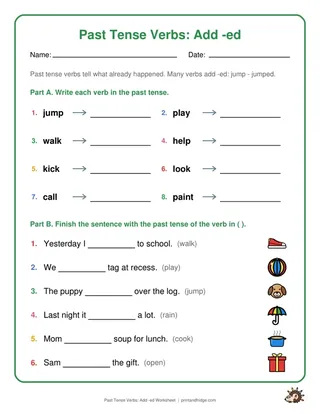
Regular past tense on one page: eight verbs to change (jump, play, walk, help, kick, look, call, paint) and six sentences that start in the past, such as Yesterday I ___ to school and Last night it ___ a lot. Small pictures next to the sentences; key on page 2. It fits second grade grammar, ages 7 to 8, with the rule printed at the top when there is one to remember.
-
4. Spelling -ed Verbs: Double, Drop or Change y
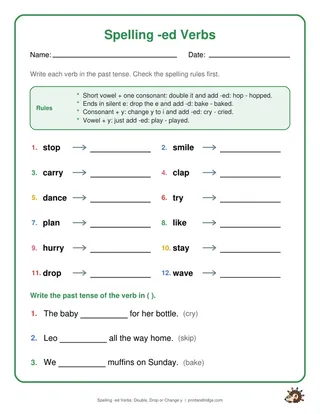
The three spelling changes of the past tense, with a rule box: double the last letter (stop - stopped, plan - planned), drop the silent e (smile - smiled, dance - danced), change y to i (carry - carried, hurry - hurried), but stay - stayed. Twelve verbs plus three sentences, key on page 2. It is a third grade grammar sheet, ages 8 to 9, where children write whole words and sentences on their own.
-
5. Irregular Past Tense Verbs Matching
Ten common irregular verbs to match with their past tense: go - went, see - saw, eat - ate, run - ran, sit - sat, come - came, make - made, swim - swam, sing - sang, fly - flew. Big type and a today/yesterday header; the key on page 2 draws the lines. It fits second grade grammar, ages 7 to 8, with the rule printed at the top when there is one to remember.
-
6. Irregular Past Tense Verbs in Sentences
Ten sentences that each need an irregular past tense verb: Last night we ___ pizza (eat), She ___ a letter to Grandma (write), The bell ___ at noon (ring), They ___ a big snowman (build). Every line has a picture clue. Answers on page 2: ate, wrote, flew, found, drank, took, rang, gave, built, slept. It is a third grade grammar sheet, ages 8 to 9, where children write whole words and sentences on their own.
-
7. Is or Are? Was or Were? Verb Agreement
Twelve sentences about subject and verb agreement: five with is or are in the present (The cat is asleep, The kids are at the park) and seven with was or were in the past (The ducks were in the pond, I was at Grandma's house). The choices are printed on each line; key on page 2. It fits second grade grammar, ages 7 to 8, with the rule printed at the top when there is one to remember.
Tips for parents and teachers
- Act out the verbs: hop, crawl, buzz and swim like the animals on the action verbs sheet.
- Use the words yesterday and last night to signal the past tense before each sentence.
- Say irregular verbs as pairs in a rhythm: sing, sang; ring, rang; swim, swam.
Did you know?
- Many of the most common English verbs are irregular, including be, have, do, go, say and see.
- Young children often say goed or eated before they learn went and ate; that is a normal sign they know the -ed rule.
Fun ways to use your printables
- Play verb charades: one person acts, the others guess the verb.
- Tell a story about yesterday and catch every past tense verb.
- Make a today and yesterday chart on the fridge for irregular verbs.
How to print
Click Download PDF and print at 100% on US Letter or A4 paper. Page 1 is the worksheet and page 2 is the answer key, so choose “page 1” in the print dialog if you only want the practice page. Every worksheet is free for home, homeschool and classroom use, so print as many copies as you need.
Frequently asked questions
What is an action verb?
A verb that tells what someone or something does: run, jump, read, swim, bake. Is, are, was and were are verbs too, but they tell what something is instead of what it does, so they have their own sheet.
How do I teach irregular past tense verbs?
Say them aloud as pairs (go, went; eat, ate; sing, sang) before writing, because children already use many of them in speech. The matching sheet comes first, then the sentence sheet asks them to write the past tense without a list.
Why does hop become hopped but jump becomes jumped?
When a short word ends in one vowel and one consonant, the last letter is doubled before -ed so the vowel stays short. The -ed spelling sheet has the three rules in a box: double it, drop the silent e, or change y to i.