Free Synonyms and Antonyms Worksheets
Updated November 2026 · 5 free printables
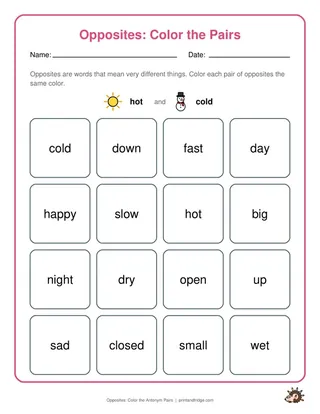
Five printable synonyms and antonyms worksheets for grades 1 to 3. First graders find eight pairs of opposites in a grid of big word boxes (hot and cold, day and night, wet and dry) and color each pair the same color.


About these printables
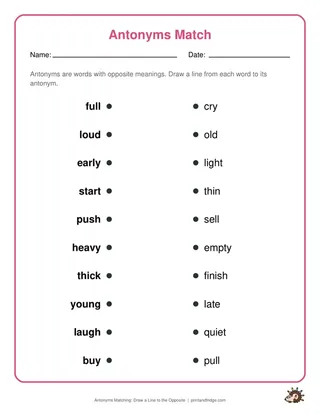
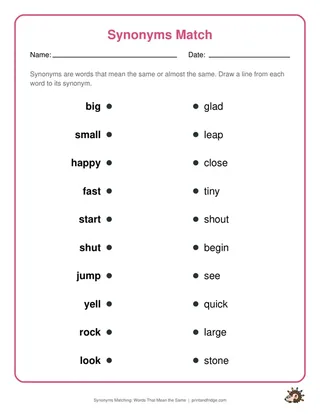
Second graders match ten antonym pairs (full and empty, push and pull, early and late) and ten synonym pairs (big and large, yell and shout, rock and stone).
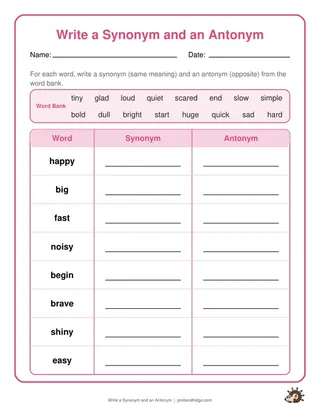
The color sort page mixes both: yellow for word pairs that mean the same (grin and smile), blue for opposites (save and spend). Third graders fill a chart with a synonym and an antonym for eight words, such as noisy, loud and quiet. Answer keys on page 2.
At a glance
- Pages
- 5 free printables, one PDF each
- Ages
- 6 to 9
- Levels
- Grade 1, Grade 2, Grade 3
- Answer keys
- on page 2 of every PDF
- Paper
- US Letter and A4
- Price
- free, no sign-up needed to download
All 5 Free Synonyms and Antonyms Worksheets, One by One
Here is a closer look at every page in this collection: what it practices, which grade it fits and a tip for each one.
-
1. Opposites: Color the Antonym Pairs
Sixteen big word boxes hiding eight pairs of opposites (hot and cold, up and down, happy and sad, day and night, open and closed, wet and dry ...). Children find each pair and color both boxes with the same crayon. The key shows the pairs in matching colors. It is a first grade grammar sheet, ages 6 to 7, with pictures or a word bank so early readers can work on their own.
-
2. Antonyms Matching: Draw a Line to the Opposite
Ten antonym pairs a step past the first opposites: full and empty, loud and quiet, early and late, start and finish, push and pull, heavy and light, thick and thin, young and old, laugh and cry, buy and sell. Big type and a key with the lines drawn. It fits second grade grammar, ages 7 to 8, with the rule printed at the top when there is one to remember.
-
3. Synonyms Matching: Words That Mean the Same
Ten pairs of synonyms to join with a line: big and large, small and tiny, happy and glad, fast and quick, start and begin, shut and close, jump and leap, yell and shout, rock and stone, look and see. Key on page 2. It fits second grade grammar, ages 7 to 8, with the rule printed at the top when there is one to remember.
-
4. Synonym or Antonym? Color the Word Pairs
Twelve word-pair cards to color: yellow for synonyms (smart and clever, grin and smile, present and gift) and blue for antonyms (above and below, save and spend, arrive and leave). Six of each, mixed up. The key shows every card in its color. It fits second grade grammar, ages 7 to 8, with the rule printed at the top when there is one to remember.
-
5. Write a Synonym and an Antonym
A three-column chart for third grade: eight words (happy, big, fast, noisy, begin, brave, shiny, easy) and a word bank of sixteen to place, one synonym and one antonym for each, such as noisy - loud - quiet and shiny - bright - dull. Key on page 2. It is a third grade grammar sheet, ages 8 to 9, where children write whole words and sentences on their own.
Tips for parents and teachers
- Use body actions for opposites: stand up for up, crouch for down, stretch for big.
- When a child repeats the same word in writing (very good, very good), suggest a synonym.
- On the color sort, read each pair aloud and ask: same or opposite?
Did you know?
- A thesaurus is a book of synonyms; the word comes from the Greek for treasure.
- Some words are their own opposites, like dust (to add dust or to remove it).
Fun ways to use your printables
- Play opposites ping-pong: say a word, the other player answers with its opposite.
- Make a big and small hunt in the house and line things up by size.
- Collect five synonyms for happy and hang them on the fridge.
How to print
Click Download PDF and print at 100% on US Letter or A4 paper. Page 1 is the worksheet and page 2 is the answer key, so choose “page 1” in the print dialog if you only want the practice page. Every worksheet is free for home, homeschool and classroom use, so print as many copies as you need.
Frequently asked questions
What is the difference between a synonym and an antonym?
A synonym means the same or almost the same (big and large); an antonym means the opposite (big and small). A simple way to remember: Same starts with S like synonym, and Anti means against.
When are opposites taught?
Opposites are often taught in kindergarten and first grade with everyday words like up and down; the words synonym and antonym usually appear in second grade, with harder pairs in third grade.
How can we practice synonyms at home?
Play a quick game in the car: one person says a word and the other has to say another word that means the same. For antonyms, say a word and answer with its opposite as fast as you can.