Sudoku for Beginners: Rules, Warm-Ups and Easy Puzzles
Updated November 2026 · 6 free printables
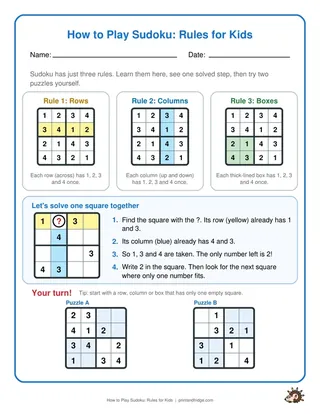
Never played sudoku? Start here. The How to Play sheet explains the three rules on small solved grids, walks through finding one missing number, and ends with two practice puzzles.


About these printables
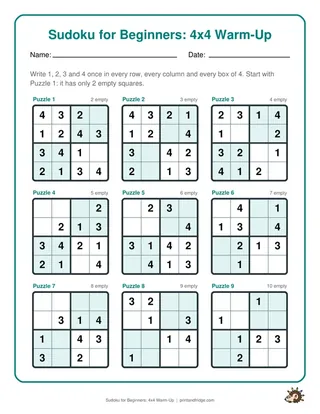
The 4x4 warm-up ladder then gives nine puzzles that add one empty square at a time, from 2 to 10.
After that, the easy 6x6 pages and the large print easy 9x9 sudoku keep many numbers in place, so every empty square can be solved with the first, simplest move: look at the row, the column and the box, and write the one number that is not there yet. Good for kids from 5 and for adults trying sudoku for the first time.
At a glance
- Pages
- 6 free printables, one PDF each
- Ages
- 3 to 6
- Answer keys
- on page 2 of every PDF
- Paper
- US Letter and A4
- Price
- free, no sign-up needed to download
All 6 Sudoku for Beginners: Rules, Warm-Ups and Easy Puzzles, One by One
Here is a closer look at every page in this collection: what it practices, which grade it fits and a tip for each one.
-
1. How to Play Sudoku: Rules for Kids
A one-page guide that teaches sudoku to kids who have never played: the three rules (rows, columns, boxes) each shown on a solved 4x4 grid with the row, column or box highlighted, a worked example that finds one missing number step by step, and two easy 4x4 puzzles to try right away. Ages 5 to 8, or anyone learning; the answer key on page 2 solves both practice puzzles. It is an easy level for first-time sudoku solvers from about age 5, with many squares already filled in. Start with the row, column or box that has the most numbers filled in.
-
2. Sudoku for Beginners: 4x4 Warm-Up
A first sudoku page that teaches by itself: nine 4x4 puzzles that start with just 2 empty squares and grow one at a time to 10, so a beginner learns the rule on the easy ones and is ready for the harder ones by the bottom row. Only the numbers 1 to 4 are used, every puzzle has a single solution, and none needs guessing. Good for ages 5 to 7 or any first-time solver; answer key on page 2. It is an easy level for first-time sudoku solvers from about age 5, with many squares already filled in. Write small pencil notes in the corners when two numbers could fit.
-
3. Easy 6x6 Sudoku for Kids
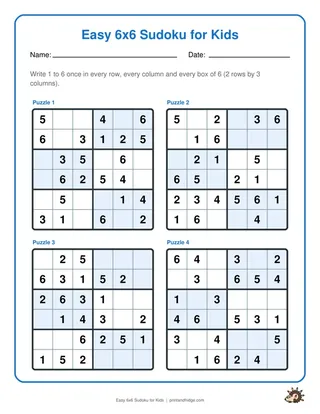
Four easy 6x6 sudoku puzzles with plenty of numbers already in place (22 to 22 of 36), the bridge between 4x4 and 9x9 sudoku. Every empty square can be found by asking which number is still missing from its row, column or box, so ages 6 to 8 can solve them alone. One solution each, answer key on page 2. It is an easy level for first-time sudoku solvers from about age 5, with many squares already filled in. Start with the row, column or box that has the most numbers filled in.
-
4. Easy 6x6 Sudoku for Kids (Set 2)
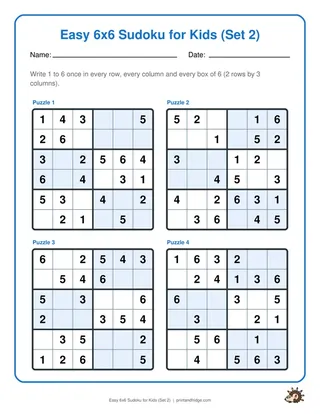
Four easy 6x6 sudoku puzzles with plenty of numbers already in place (22 to 22 of 36), the bridge between 4x4 and 9x9 sudoku. Every empty square can be found by asking which number is still missing from its row, column or box, so ages 6 to 8 can solve them alone. One solution each, answer key on page 2. It is an easy level for first-time sudoku solvers from about age 5, with many squares already filled in. Start with the row, column or box that has the most numbers filled in.
-
5. Large Print Easy Sudoku for Kids
One easy 9x9 sudoku printed large: the grid fills the page, each square is about three quarters of an inch, and the numbers are big and bold, easy on young eyes and room for pencil notes. 37 of the 81 numbers are given. Every empty square can be found just by checking which number is missing from its row, column and box. For ages 7 and up, including first-time 9x9 solvers; answer key on page 2. It is an easy level for first-time sudoku solvers from about age 5, with many squares already filled in. Write small pencil notes in the corners when two numbers could fit.
-
6. Large Print Easy Sudoku for Kids (Set 2)
One easy 9x9 sudoku printed large: the grid fills the page, each square is about three quarters of an inch, and the numbers are big and bold, easy on young eyes and room for pencil notes. 37 of the 81 numbers are given. Every empty square can be found just by checking which number is missing from its row, column and box. For ages 7 and up, including first-time 9x9 solvers; answer key on page 2. It is an easy level for first-time sudoku solvers from about age 5, with many squares already filled in. Write small pencil notes in the corners when two numbers could fit.
Tips for sudoku for beginners: rules, warm-ups and easy puzzles
- Learn the three rules on the How to Play sheet before trying a puzzle.
- Write one number at a time and check its row, column and box before the next.
- When a puzzle feels too hard, go back one level for a day.
Fun math facts
- Most beginner puzzles can be solved with one move: finding the only number that fits a square.
- Sudoku needs no arithmetic; letters or pictures would work just as well.
Fun ways to use your printables
- Solve the warm-up ladder together, taking turns square by square.
- Keep the large print easy 9x9 for a car trip or a waiting room.
How to print
Click Download PDF and print at 100% on US Letter or A4 paper. Page 1 is the worksheet and page 2 is the answer key, so choose “page 1” in the print dialog if you only want the practice page. Every worksheet is free for home, homeschool and classroom use, so print as many copies as you need.
Frequently asked questions
What is the easiest way to learn sudoku?
Begin with a small grid. A 4x4 sudoku uses only four numbers, so the rule is easy to see. Solve a few with someone, saying the reasoning out loud, then move to 6x6 and 9x9.
What is the first trick every sudoku beginner should know?
Pick one empty square and list the numbers already in its row, column and box. If only one number is left, that is the answer. On easy puzzles this trick alone solves the whole grid.
Should beginners use a pencil?
Yes. A pencil and eraser take the fear out of mistakes. On 9x9 puzzles, small pencil notes in the corner of a square help keep track of the numbers that could still fit.