Number Line Worksheets and Printable Number Lines
Updated November 2026 · 23 free printables
Free printable number lines and number line worksheets from pre-K to fifth grade: 23 PDFs, each on US Letter paper.
By signing up you agree to our privacy policy and to occasional emails with new printables. Unsubscribe any time.
Thank you! Your PDF is downloading. If it did not start, tap here to download it.


About these printables
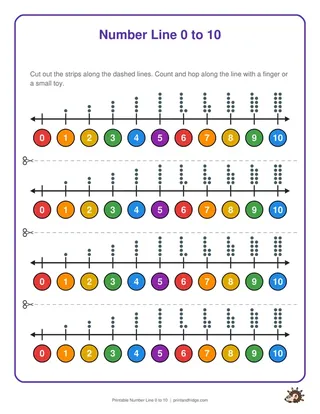
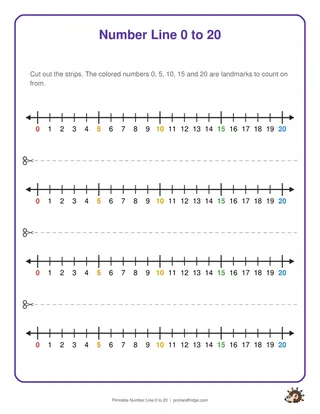
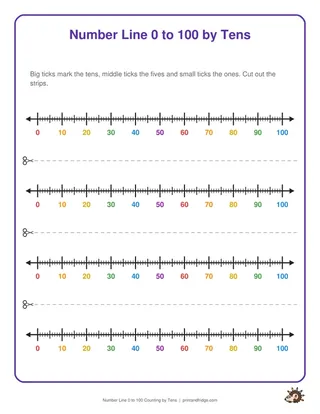
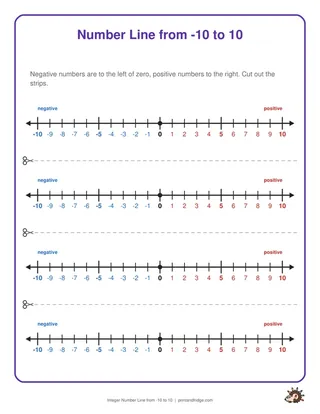
Eleven are number lines to print and keep: strips from 0 to 10 with counting dots, 0 to 20 with the fives in color, 0 to 100 by tens with ruler-style ticks, all of 0 to 100 in five rows, integer lines from -10 to 10 and a vertical one from -20 to 20, fraction number lines from 0 to 1 and from 0 to 2, a decimal number line with a zoom into the hundredths, a blank template with tick marks and boxes, and open number lines. The strip pages hold two to four copies to cut apart for desks.
Twelve are worksheets with an answer key on page 2: hop to add and hop back to subtract within 10, read the hops and write the number sentence (to 20), missing numbers to 20 and to 100 (with two lines that count backward), skip counting by 2s, 5s, 10s, 25s and 100s, two-digit addition on an open number line with jumps of ten, rounding to the nearest ten, placing fractions, equivalent fractions on two lines, placing decimals and adding and subtracting integers. The keys draw every hop and point in red, so you can check the method, not just the answer.
At a glance
- Pages
- 23 free printables, one PDF each
- Ages
- 3 to 11
- Levels
- Pre-K to Grade 5
- Answer keys
- 12 of the 23 pages have one on page 2
- Paper
- US Letter and A4
- Complete pack
- all 23 pages in one PDF, free with an email sign-up
- Price
- free; every single page downloads with no sign-up
Number Line Worksheets and Printable Number Lines, One by One
A closer look at the pages that belong to this collection itself. The other pages in the gallery above are described on their own theme pages, linked from each card.
-
1. Hop to Add on a Number Line Within 10
Six addition problems within 10, each with its own big 0 to 10 number line. Children start on the first number, draw one hop for every number they add and write the number they land on. The answer key on page 2 shows the start dot, every hop in red and the sum. A first number line page for kindergarten. Big pictures and only a few tasks per page make it a gentle start for kindergartners. Use small objects like buttons or cereal to check tricky problems.
-
2. Hop Back to Subtract on a Number Line Within 10
Six subtraction problems within 10 with a 0 to 10 number line under each one. Kids start on the first number, hop backward once for every number taken away and write where they stop. Page 2 is the answer key with the hops drawn in red, so a grown-up can check the counting and not just the answer. It suits ages 4 to 6, and little ones can count the pictures with a finger. Check each answer by adding it back to the number taken away.
-
3. Read the Hops: Number Line Equations to 20
The hops are already drawn: six 0 to 20 number lines each show a starting dot and a row of blue jumps going forward or back. First graders read the picture and write the number sentence, start number, plus or minus, number of hops and the answer, in five boxes. It turns the usual task around and checks that children really understand what a hop means. Answer key included. First graders can do it on their own once they know the strategy at the top of the page. Have your child say each fact out loud while writing the answer.
-
4. Missing Numbers on a Number Line 0 to 20
Eight number lines, each a stretch of eleven numbers somewhere between 0 and 20, with four numbers missing on every line. Kindergarten and first grade children count along the ticks and write the missing numbers in the boxes, which builds number order and the teen numbers. The red answer key is on page 2. It matches first grade goals, roughly ages 6 to 7.
-
5. Missing Numbers on a Number Line to 100
Eight number lines with numbers between 21 and 99 and four blanks on each: six lines count forward and the last two count backward, which is where children usually slip (from 61 back to 59, for example). Good practice for crossing a ten in first and second grade, with an answer key on page 2. It matches first grade goals, roughly ages 6 to 7.
-
6. Skip Counting on a Number Line
Eight number lines that skip count by 2s, 5s, 10s, 25s and 100s, each starting at a different number and missing four values. Students first work out the step from the numbers they can see, then fill in the boxes. Skip counting on a line prepares second graders for multiplication and for counting money. Answer key included. It fits second grade, around ages 7 to 8. Say the row out loud to hear the pattern.
-
7. Add Two-Digit Numbers on an Open Number Line
Six two-digit addition problems (sums up to 99) with an open number line under each one, already marked with the starting number. Second graders jump by tens and then add the ones in one jump, writing each landing number. The answer key draws the jumps (+10, +10, +5) in red with every stop labeled, the strategy most US math programs teach before the column method. Second graders usually finish it in 10 to 15 minutes. Have your child say each fact out loud while writing the answer.
-
8. Rounding to the Nearest 10 on a Number Line
Eight rounding problems where each number is shown as a dot on a short number line between its two tens: four two-digit and four three-digit numbers, including one that ends in 5. Third graders look at which ten is closer and write the rounded number. The answer key draws an arrow from the dot to the nearest ten, so the rule for 5 (round up) is easy to explain. It is aimed at third grade, around ages 8 to 9. Say the number in tens and ones: 47 is 4 tens and 7 ones.
-
9. Place Decimals on a Number Line
Six number lines for plotting decimals: four lines from 0 to 1 in tenths, where students mark two decimals such as 0.3 and 0.8, and two zoomed-in lines in hundredths (for example from 0.6 to 0.7) for numbers like 0.64. Only the ends are labeled, so children have to count the steps. Each point gets a letter; the key shows every point in red. Expect it to take fourth graders about 15 to 20 minutes with careful work.
-
10. Adding and Subtracting Integers on a Number Line
Six integer problems such as (-3) + 5 and 2 - 6, each with a -10 to 10 number line (negatives in blue, positives in red). Every problem starts or ends below zero, so students practice crossing zero by hopping right to add and left to subtract. A bridge from fifth grade to the sixth grade integer standards; the key shows the hops in red. Fifth graders can use it to review before moving on to harder fraction work. Have your child say each fact out loud while writing the answer.
Tips for number line worksheets and printable number lines
- Let children hop with a finger or a small toy on the line before they draw hops with a pencil.
- Always mark the start number with a dot first; most mistakes come from counting the start as a hop.
- Say "forward" for adding and "back" for subtracting while hopping, so the direction sticks.
- Keep a 0 to 20 strip on the desk during any addition or subtraction worksheet.
- Ask children to explain one problem out loud: "I started at 8 and hopped 5 times to 13."
Fun math facts
- Number lines appear in the US Common Core standards from grade 2 (whole numbers) to grade 6 (negative numbers).
- On a horizontal number line, numbers always get bigger to the right and smaller to the left.
- The open number line was popularized by Dutch math educators in the 1990s as a tool for mental arithmetic.
- Zero is neither positive nor negative; it sits in the middle of the integer number line.
Fun ways to use your printables
- Tape a number line on the floor with painter's tape and let kids jump the hops for real.
- Make a clothesline number line: clip number cards on a string and ask children to put them in order.
- Play guess my number: give clues like "it is between 30 and 40 and closer to 40".
- Use the vertical line to track the outside temperature for a week.
How to print
Click Download PDF and print at 100% on US Letter or A4 paper. Page 1 is the worksheet and page 2 is the answer key, so choose “page 1” in the print dialog if you only want the practice page. Every worksheet is free for home, homeschool and classroom use, so print as many copies as you need.
Frequently asked questions
Are these number lines free to print?
Yes. Every chart and worksheet is a free PDF with no sign-up and no email, for home, homeschool or classroom use.
Which number line should I use for kindergarten?
Start with the 0 to 10 strips (the dots above each number show the amount) and the Hop to Add and Hop Back to Subtract worksheets. Move to the 0 to 20 strips when children add and subtract within 20, usually late in kindergarten or in first grade.
What is an open number line?
A line with no numbers or ticks. Children mark only the numbers they need: for 34 + 25 they write 34, jump 10 to 44, 10 to 54 and 5 to 59. It is a common second grade strategy for adding and subtracting in your head. Use the Open Number Line Template for any problem, or the Add Two-Digit Numbers worksheet for guided practice.
How do number lines help with fractions?
A number line shows that a fraction is a number with its own place between 0 and 1 (or beyond), not just a slice of pizza. The stacked fraction lines show that 1/2, 2/4, 3/6 and 4/8 land on the same point, and the 0 to 2 lines show that 4/4 equals 1.
Do the worksheets have answer keys?
All twelve worksheets do, on page 2 of the PDF, with hops, dots and answers drawn in red. The eleven charts and templates have no key because there is nothing to solve.
Can I use the strips as a desk number line?
Yes. Cut along the dashed lines, laminate the strips or cover them with clear tape, and tape one to each desk. The 0 to 20 and 0 to 100 by tens strips are the ones most classrooms use.
Are there number lines with negative numbers?
Yes: four strips from -10 to 10, a vertical line from -20 to 20 like a thermometer, and a worksheet for adding and subtracting integers on a -10 to 10 line. Negatives are blue and positives red on all three.