Free Printable Alphabet Chart (ABC Chart) and Flash Cards
Updated November 2026 · 13 free printables
Free printable alphabet charts for preschool and kindergarten (ages 3 to 6): 13 pages in all, each a one-page PDF on US Letter paper with no sign-up.
By signing up you agree to our privacy policy and to occasional emails with new printables. Unsubscribe any time.
Thank you! Your PDF is downloading. If it did not start, tap here to download it.


About these printables
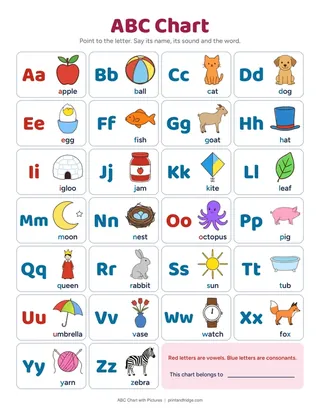
The main ABC chart shows all 26 letters, uppercase and lowercase, with a color picture and its word, from apple, ball and cat to yarn and zebra. On every page the five vowels are red and the consonants are blue, the way school primers have marked them for generations, so a child sees the two kinds of letters long before anyone explains the rule.
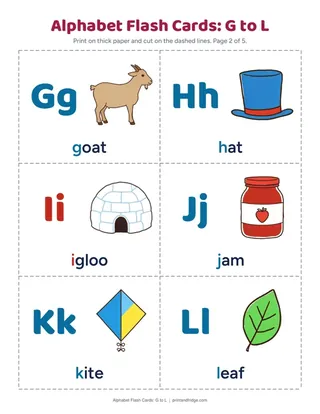
Besides the picture chart there are three letter-only charts (uppercase with lowercase, capitals only, small letters only), a vowels and consonants chart, a black-and-white chart where the child colors each letter and draws a picture for it, a page of four mini charts for folders and pencil boxes, and a page of desk strips and name plates. The alphabet flash cards are a five-page set: six large cards per page for A to X, then Y, Z and four blank cards for the child's own letters and drawings.
At a glance
- Pages
- 13 free printables, one PDF each
- Ages
- 3 to 6
- Levels
- Pre-K, Kindergarten
- Paper
- US Letter and A4
- Complete pack
- all 13 pages in one PDF, free with an email sign-up
- Price
- free; every single page downloads with no sign-up
Free Printable Alphabet Chart (ABC Chart) and Flash Cards, One by One
A closer look at the pages that belong to this collection itself. The other pages in the gallery above are described on their own theme pages, linked from each card.
-
1. ABC Chart with Pictures
A free printable ABC chart in color: all 26 letters, uppercase and lowercase, each with a picture and its word, from apple to zebra. Vowels are red and consonants are blue, and there is a line for the child's name. One US Letter page for the fridge, a binder or a classroom wall. It is made for pre-K and preschool, roughly ages 4 to 5, with big pictures and one number per page.
-
2. Alphabet Chart: Uppercase and Lowercase
A clean alphabet chart without pictures: the 26 capital letters, each next to its lowercase partner, in big rounded print. Vowels are red and consonants are blue. Good for matching capital and small letters and for children who already know the picture words. Little ones can do most of it with crayons, and a grown-up can read the short questions aloud.
-
3. Uppercase Alphabet Chart
The 26 capital letters in extra-large print, one per box, with the five vowels in red. Capital letters are the easiest shapes to tell apart, so this is the chart to start with for toddlers and preschoolers. Little ones can do most of it with crayons, and a grown-up can read the short questions aloud.
-
4. Lowercase Alphabet Chart
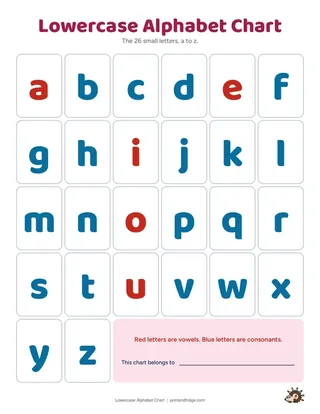
The 26 lowercase letters in extra-large print, one per box, vowels in red and consonants in blue. Most of the text a child reads is lowercase, so hang this one where early readers can check b, d, p and q at a glance. Big pictures and only a few tasks per page make it a gentle start for kindergartners.
-
5. Alphabet Chart to Color and Draw
A black-and-white alphabet chart that saves ink: 26 boxes with hollow uppercase and lowercase letters to color, and an empty space in every box where the child draws something that starts with that letter. The finished page becomes a homemade ABC chart signed by its artist. Little ones can do most of it with crayons, and a grown-up can read the short questions aloud.
-
6. Vowels and Consonants Chart
A one-page color chart that sorts the alphabet into its two groups: the five vowels A, E, I, O, U in red, each with a short-vowel picture word (apple, egg, igloo, octopus, umbrella), and the 21 consonants in blue with a picture each. A note explains why Y sometimes acts like a vowel. Big pictures and only a few tasks per page make it a gentle start for kindergartners.
-
7. Alphabet Desk Strips and Name Plates
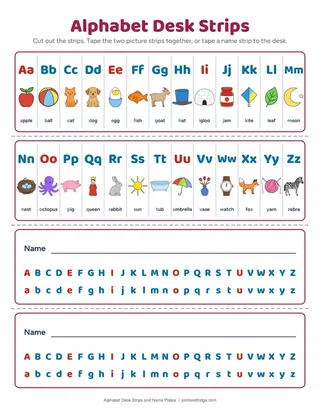
Four strips on one page: a two-part alphabet line with a picture and a word under every letter (tape the halves together for a 15-inch strip), plus two desk name plates with a name line and the whole alphabet in uppercase and lowercase. Vowels are red, consonants blue. It suits ages 4 to 6, and little ones can count the pictures with a finger.
-
8. Mini ABC Charts, 4 per Page
Four pocket-size alphabet charts with pictures on one page, each about 3.8 by 4.6 inches. Cut them apart and glue one inside a writing folder, a homework notebook or a pencil box so the letters and their picture clues are always within reach. It suits ages 4 to 6, and little ones can count the pictures with a finger.
Tips for parents and teachers
- Hang the chart at the child's eye level, not the adult's. The fridge door or the side of a bookshelf is better than a high wall.
- Point and say three things for each box: the letter name, the sound and the word. A, a, apple.
- Sing the alphabet song slowly while the child points. L, M, N, O, P are five separate boxes, not one fast word.
- Start with the letters in the child's name and circle them with a dry-erase marker on a chart in a sheet protector.
- Five letters a day is enough. Stop while it is still a game.
Did you know?
- The English alphabet has 26 letters: 5 vowels and 21 consonants. Y can work as either one.
- The word alphabet comes from alpha and beta, the first two letters of the Greek alphabet.
- E is the most used letter in English and Z is among the least used.
- The alphabet song shares its tune with Twinkle, Twinkle, Little Star.
- A sentence that uses every letter is called a pangram. The best known is: The quick brown fox jumps over the lazy dog.
Fun ways to use your printables
- Play I spy with the chart: I spy something that starts with the sound sss.
- Cover one picture with a sticky note and ask which word is hiding.
- Glue a mini chart inside the cover of a writing notebook so the letters are there when a word needs spelling.
- Let the child color the black-and-white chart over a week, three or four letters a day, and hang the finished page on the fridge.
- Tape a name strip to the table where homework happens and write the name with a marker that wipes off.
How to print
Click Download PDF and print at 100% on US Letter or A4 paper. Page 1 is the worksheet and page 2 is the answer key, so choose “page 1” in the print dialog if you only want the practice page. Every worksheet is free for home, homeschool and classroom use, so print as many copies as you need.
Frequently asked questions
Is the alphabet chart free to print?
Yes. Every chart and every flash card page is a free PDF on US Letter paper, and it also prints well on A4. There is no sign-up and no email for single pages. Print as many copies as you need for home or for a class.
Which chart should I start with for a 3-year-old?
Start with the ABC Chart with Pictures. The picture gives the child something to say out loud, and the letter comes along with it. If 26 boxes feel like too much, print the Uppercase Alphabet Chart and learn the letters of the child's name first.
Why are some letters red and some blue?
Red letters are the vowels A, E, I, O and U. Blue letters are consonants. Every English word needs at least one vowel sound, so children who notice the red letters early find it easier to sound out words like cat, pig and sun later on.
Why does the letter X show a fox?
Very few simple words start with the sound of X, and x-ray and xylophone begin with other sounds. In fox, box and six the letter makes its usual ks sound at the end of the word, which is where children will actually meet it.
How do I make the flash cards last?
Print them on card stock or glue the page to a cereal box before cutting. A strip of clear packing tape over each card works almost as well as laminating. Keep the 26 cards in an envelope or on a ring with a hole punched in one corner.
Is there a black-and-white version?
Yes. The Alphabet Chart to Color and Draw uses only black ink: hollow letters to color and an empty space in every box for the child's own drawing. The letter-only charts also print clearly in grayscale; the vowels simply come out a little lighter.
What size are the cards and the mini charts?
Each flash card is 3.75 by 3 inches, six to a page. The mini charts are about 3.8 by 4.6 inches, four to a page. The two picture strips are 7.7 inches long each and make a 15-inch desk strip when taped together.