Dots and Boxes Printable Game Boards
Updated November 2026 · 14 free printables
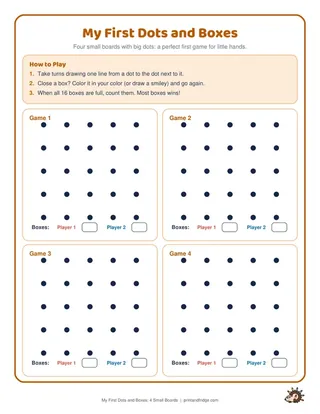
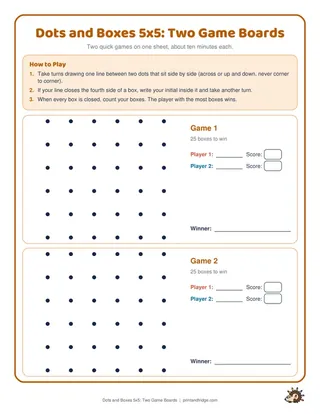
Free printable dots and boxes game boards in every size: four 4 by 4 boards with big dots for preschool, two-board pages in 5 by 5 and 6 by 6, and single boards in 8 by 8, 10 by 10 and 12 by 12.
By signing up you agree to our privacy policy and to occasional emails with new printables. Unsubscribe any time.
Thank you! Your PDF is downloading. If it did not start, tap here to download it.


About these printables
For a change, play on a heart, a Christmas tree or a five-point star, where only the shaded squares count, or try the bonus versions: ten golden star boxes worth 3 points on a 9 by 9 board, or a math board where every box shows a value from 1 to 5 and the highest sum wins.
Every board has the rules in a box at the top and name and score lines for two players, and the road trip pack, the restaurant placemat and the rainy day pack each include a dots and boxes board too. Dots and boxes looks simple, but the end of every game is about chains of boxes: kids who learn not to draw the third side of a box start to win, and older players learn to give away two boxes to keep control.
At a glance
- Pages
- 14 free printables, one PDF each
- Ages
- 3 to 10
- Levels
- Pre-K to Grade 4
- Paper
- US Letter and A4
- Complete pack
- all 14 pages in one PDF, free with an email sign-up
- Price
- free; every single page downloads with no sign-up
Dots and Boxes Printable Game Boards, One by One
A closer look at the pages that belong to this collection itself. The other pages in the gallery above are described on their own theme pages, linked from each card.
-
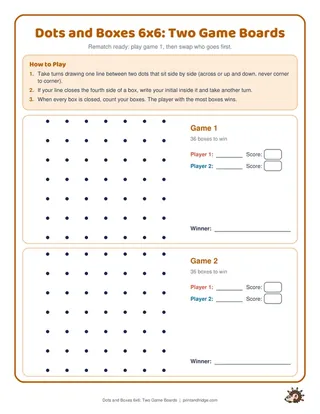
1. Dots and Boxes 6x6: Two Game Boards
Two 6 by 6 dots and boxes boards (36 boxes each) with space beside each board for both players' names, scores and the winner. Six by six is where strategy starts: kids notice that drawing the third side of a box gives it away, and they begin to count chains. It suits ages 6 to 7: quick to learn, and a game is over before anyone gets restless.
-
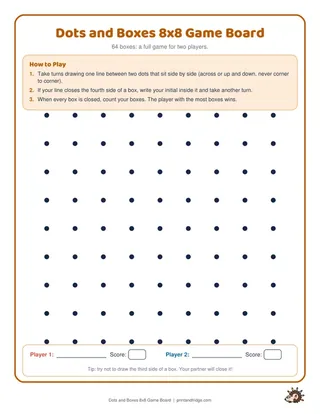
2. Dots and Boxes 8x8 Game Board
One large 8 by 8 dots and boxes board with 64 boxes, the classic size for a full game of about 20 minutes. The page has the three rules in a box at the top, two name and score lines at the bottom and a strategy tip. Use two pencil colors so it is easy to see who drew which line. It fits ages 7 and up: a little more strategy, still quick to explain.
-
3. Dots and Boxes 10x10 Game Board
A 10 by 10 dots and boxes board with 100 boxes for a long game, great for older kids, family game night or three players taking turns. Rules at the top, score lines at the bottom. Big boards reward planning: whoever controls the long chains at the end usually wins. Third graders and up, about ages 8 and older, get a real strategy game out of it, and grown-ups enjoy it too.
-
4. Dots and Boxes 12x12 Game Board
The biggest board in the set: 12 by 12 dots and boxes with 144 boxes, for older kids and grown-ups who want a real strategy game on a single sheet of paper. Play with two or three players, or two teams. Rules and score lines included; the dots still sit half an inch apart, so lines are easy to draw. It is a strategy game for ages 9 and up, good for older kids, teens and grown-ups playing together.
-
5. Heart Dots and Boxes Game
A dots and boxes board shaped like a big heart, with 97 boxes shaded light pink so players can see which lines count. A sweet Valentine's Day game for a class party, a lunch box surprise or a quiet game with a grandparent. The odd shape makes new tricks: the narrow bottom tip and the two bumps at the top become little traps. First graders, about ages 6 to 7, can read the short rules and play it with a friend or sibling. Try a rainbow of hearts.
-
6. Christmas Tree Dots and Boxes Game
A Christmas tree made of 69 dots-and-boxes squares, shaded light green, with a trunk at the bottom and six yellow star boxes hung like ornaments. A star box is worth 3 points, so players fight over them. A fun Christmas break game for the kids' table, holiday travel or a classroom party. It suits ages 6 to 7: quick to learn, and a game is over before anyone gets restless. Red, green and gold make a classic Christmas palette.
-
7. Star Dots and Boxes Game
A dots and boxes board in the shape of a five-point star, 62 boxes shaded light yellow. The five narrow points are where games are won and lost: a point is a ready-made chain, and the player who has to open it gives away several boxes. Good for second grade and up, for Fourth of July, a star student day or just a new twist on the classic. Second graders, about ages 7 to 8, enjoy the extra planning this version asks for.
-
8. Dots and Boxes with Bonus Stars
A 9 by 9 dots and boxes board where ten boxes hold a golden star worth 3 points. The stars change the game: a player may give away two plain boxes to win one star, so kids start adding and comparing instead of just counting. Score lines for both players at the bottom. It fits ages 7 and up: a little more strategy, still quick to explain.
-
9. Dots and Boxes Math Game: Number Boxes
A 7 by 7 dots and boxes board where every box shows a point value from 1 to 5 (132 points in all). Players still take turns drawing lines, but the winner is the one with the higher sum, not the most boxes, so a single 5 can beat three 1s. Addition practice that kids actually ask to play; great for second and third grade math centers. Second graders, about ages 7 to 8, enjoy the extra planning this version asks for. Use small objects like buttons or cereal to check tricky problems.
Tips for coloring Dots and Boxes Printable Game Boards
- Use two pencil colors so it is easy to see who drew each line.
- For beginners, color the boxes you win instead of writing an initial: it is faster and more fun to count.
- Never draw the third side of a box unless you have to; your partner will close it and go again.
- On the shaped boards, trace the outline of the shape with a light color first so kids see which lines count.
Fun facts about Dots and Boxes Printable Game Boards
- Dots and boxes was first published by the French mathematician Edouard Lucas in 1889.
- Mathematicians have written whole books about dots and boxes strategy, especially the long chains at the end.
- A 5 by 5 board has 60 lines to draw in all; a 12 by 12 board has 312.
Fun ways to use your printables
- Play the number-box board as a math center: kids add their boxes on the back of the sheet.
- Play a three-player game on the 12 by 12 board with three pencil colors.
- Use the heart board for Valentine's Day and the Christmas tree board for winter break.
How to print
Click Download PDF on any page and print it at 100% on US Letter or A4 paper. Use regular printer paper for crayons and pencils, or cardstock for markers and paint. Every page here is free for home, classroom and party use, so feel free to print as many copies as you need.
Frequently asked questions
What size dots and boxes board should I print?
For ages 3 to 5, use the 4 by 4 boards (16 boxes, about five minutes). For ages 5 to 7, the 5 by 5 and 6 by 6 pages give two games each. The 8 by 8 board is the classic full game, and 10 by 10 or 12 by 12 suit older kids and grown-ups who want a long game.
Who wins dots and boxes?
The player with the most boxes when every box is closed. On the bonus star board a star box counts 3 points, and on the number board each box counts the number inside it, so the winner is the highest total.
Is there a winning strategy for dots and boxes?
Avoid drawing the third side of a box, because your partner will close it and go again. Near the end the board breaks into chains; a strong player sometimes leaves the last two boxes of a chain to the other player, so the other player has to open the next chain.
Can three people play dots and boxes?
Yes. Use the 10 by 10 or 12 by 12 board, give each player a different colored pencil and take turns in a circle. The rules stay the same.