Kindergarten Handwriting Worksheets
Updated November 2026 · 8 free printables
Free printable kindergarten handwriting worksheets that go past single letters: 8 sheets of real kindergarten writing practice.
By signing up you agree to our privacy policy and to occasional emails with new printables. Unsubscribe any time.
Thank you! Your PDF is downloading. If it did not start, tap here to download it.


About these printables
Kids sort tall, small and tail letters, write pet names with a capital letter, copy first sentences, leave finger spaces, finish their own sentences, write their own name, copy a shopping list and check their best handwriting with a five-star list.
Every sheet uses three-line handwriting paper with a dotted middle line and green start dots, the layout most US kindergartens use. The finger spaces sheet has an answer key; the others are open writing pages. All are free PDFs for US Letter paper, with no sign-up.
At a glance
- Pages
- 8 free printables, one PDF each
- Ages
- 5 to 6
- Answer keys
- 1 of the 8 pages have one on page 2
- Paper
- US Letter and A4
- Complete pack
- all 8 pages in one PDF, free with an email sign-up
- Price
- free; every single page downloads with no sign-up
All 8 Kindergarten Handwriting Worksheets, One by One
Here is a closer look at every page in this collection: what it practices, which grade it fits and a tip for each one.
-
1. Tall, Small and Tail Letters Handwriting Practice
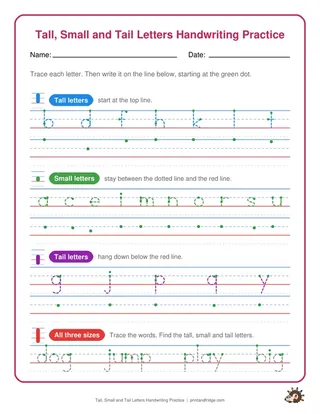
Letters sorted by how they sit on the writing lines: seven tall letters (b, d, f, h, k, l, t), ten small letters (a, c, e, i, m, n, o, r, s, u) and five tail letters (g, j, p, q, y). Kids trace each group, write it again from the start dots, then trace four words that mix all three sizes: dog, jump, play, big. Big pictures and only a few tasks per page make it a gentle start for kindergartners.
-
2. Names Start with a Capital Letter: Pet Name Tags
Six pets with name tags: Max the dog, Tom the cat, Pam the pig, Dot the hen, Hop the frog and Ben the duck. Kids trace each three-letter name with its capital letter in color, then write it on the line below. A first lesson on one capital at the start of a name, the rest small. Big pictures and only a few tasks per page make it a gentle start for kindergartners.
-
3. Sentence Copying: Read, Trace and Write
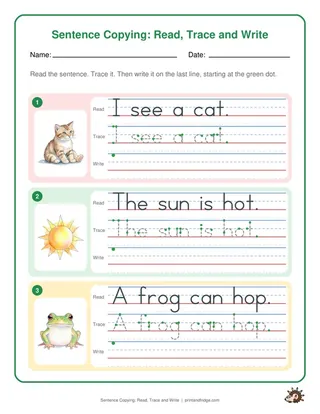
Three first sentences made of sight words and one picture word: I see a cat. The sun is hot. A frog can hop. Each has a picture, the sentence in print to read, the same sentence in dashes to trace and an empty line with a green starting dot to write it alone. Big pictures and only a few tasks per page make it a gentle start for kindergartners.
-
4. Finger Spaces: Leave a Space Between Words
Spacing practice in two parts. First kids trace and copy three short sentences with an orange mark in every gap between words. Then they fix two squished sentences, Icanhop. and Thecatsat., by writing them again with spaces. The answer key is on page 2. It suits ages 4 to 6, and little ones can count the pictures with a finger.
-
5. Finish the Sentence: Write and Draw
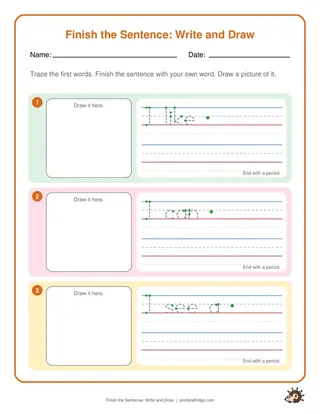
Three sentence starters for a child's first own sentences: I like, I can and I see a. Kids trace the starter, add their own ending on the handwriting lines and draw what they wrote in the box. Inventive spelling is welcome here; the goal is a whole thought on paper. Big pictures and only a few tasks per page make it a gentle start for kindergartners.
-
6. Name Writing Practice: All About My Name
A name page that works for any name. A grown-up writes the name once as a model; the child writes it three times with three crayons, counts its letters, writes its first letter and circles the letters of the name in an A to Z grid. It suits ages 4 to 6, and little ones can count the pictures with a finger.
-
7. Copy the Shopping List: Handwriting Practice
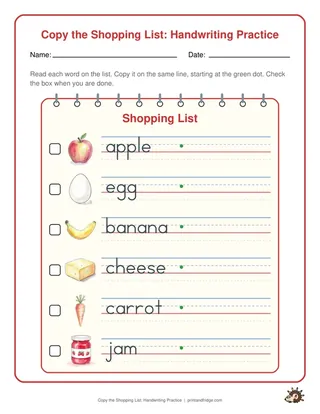
Handwriting with a real-life job: a shopping list on a notepad with six foods, each with its picture: apple, egg, banana, cheese, carrot and jam. Kids copy every word next to its model and tick the box, the way a grown-up ticks off a list. It suits ages 4 to 6, and little ones can count the pictures with a finger.
-
8. My Best Handwriting: Copy and Check
Two sentences to copy, My cat is big. She naps on the rug., on three handwriting lines, followed by a five-star checklist the child fills in alone: letters on the line, tall letters touching the top, finger spaces, a capital letter at the start and a period at the end. Big pictures and only a few tasks per page make it a gentle start for kindergartners.
Tips for parents and teachers
- Seat the child with both feet on the floor and the paper turned slightly.
- Short pencils and broken crayons build a better grip than fat markers.
- Praise one thing that is right before fixing anything that is wrong.
Did you know?
- Writing letters by hand helps children remember them better than typing them.
- Most kindergartners still reverse some letters; it usually fades by second grade.
Fun ways to use your printables
- Let the child write the real shopping list for the next trip to the store.
- Write a short note in the lunch box and ask for a one-line answer.
How to print
Click Download PDF and print at 100% on US Letter or A4 paper. Page 1 is the worksheet and page 2 is the answer key, so choose “page 1” in the print dialog if you only want the practice page. Every worksheet is free for home, homeschool and classroom use, so print as many copies as you need.
Frequently asked questions
What handwriting should a kindergartner be able to do?
By the end of kindergarten most children write all letters, their first and last name, and short sentences like I see a cat., with spaces between the words and a period at the end. Neat is nice; readable is the goal.
What are tall, small and tail letters?
Tall letters (b, d, f, h, k, l, t) touch the top line, small letters (a, c, e, m, o and more) stay under the dotted line, and tail letters (g, j, p, q, y) hang below the bottom line. Knowing the three groups fixes most messy writing.
How do I teach finger spaces?
After each word the child puts one finger on the line and starts the next word on the other side of it. The finger spaces sheet marks each gap in orange first, then asks the child to fix two squished sentences.
My child holds the pencil in a fist. Should I worry?
At five, many children still change grip. Short, thick crayons and broken crayon pieces push the fingers into a pincer grip by themselves. If it still hurts or tires the hand quickly at six, ask the teacher.
How long should handwriting practice take?
Ten minutes is plenty at this age. One sheet a day, finished with care, beats three sheets done in a hurry.