Kindergarten Phonics Worksheets
Updated November 2026 · 8 free printables
Free printable kindergarten phonics worksheets: 8 one-page sheets for ages 5 and 6 that train the ear before the eye.
By signing up you agree to our privacy policy and to occasional emails with new printables. Unsubscribe any time.
Thank you! Your PDF is downloading. If it did not start, tap here to download it.


About these printables
Children hear the first, middle and last sound in a word, count the sounds in bee, cat and frog, clap syllables from sun to watermelon, swap the first sound to turn cat into hat, blend b + ug into bug and decide whether a word really matches its picture.
Every sheet uses watercolor pictures of everyday things, so a child who cannot read yet still knows the word. All 8 sheets have an answer key on page 2. They are free PDFs for US Letter paper that also print on A4, with no account and no email needed.
At a glance
- Pages
- 8 free printables, one PDF each
- Ages
- 5 to 6
- Answer keys
- on page 2 of every PDF
- Paper
- US Letter and A4
- Complete pack
- all 8 pages in one PDF, free with an email sign-up
- Price
- free; every single page downloads with no sign-up
All 8 Kindergarten Phonics Worksheets, One by One
Here is a closer look at every page in this collection: what it practices, which grade it fits and a tip for each one.
-
1. Kindergarten Phonics Review Worksheet
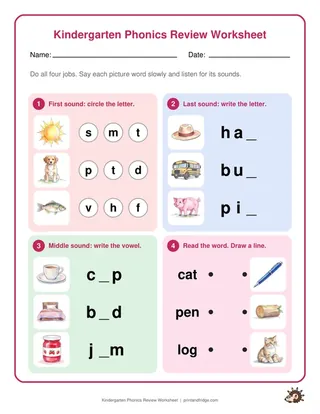
One page that checks four kindergarten phonics skills: circle the first sound (sun, dog, fish), write the last letter (hat, bus, pig), write the middle vowel (cup, bed, jam) and match the words cat, pen and log to their pictures. Twelve short answers, good as a weekly review or a quick check before report cards. The answer key is on page 2. It suits ages 4 to 6, and little ones can count the pictures with a finger. Do one exercise at a time and check it with the key.
-
2. Ending Sounds: Circle the Last Letter
Nine pictures, each with three letters under it: the last letter of the word, its first letter and one more. Kids say bus, hat, pig, sun, cup, bed, drum, fox and leaf and circle the letter they hear at the end, which is harder than hearing the first sound because the first letter is always one of the choices. The answer key is on page 2. It suits ages 4 to 6, and little ones can count the pictures with a finger.
-
3. Where Is the Sound? First, Middle or Last
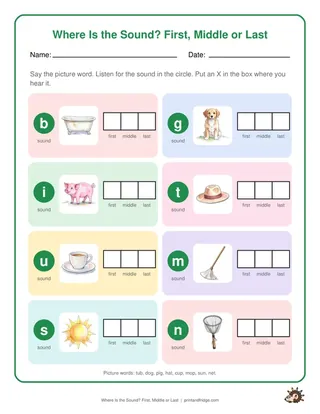
Eight pictures with a letter sound and three boxes: first, middle, last. Kids say the word (sun, hat, pig, mop, dog, cup, tub, net) and mark where they hear the sound. Three sounds are at the start, two are the vowel in the middle and three are at the end. The answer key is on page 2. Big pictures and only a few tasks per page make it a gentle start for kindergartners.
-
4. Count the Sounds: How Many Do You Hear?
Sound counting for nine picture words with two, three or four sounds: bee and key (2), cat, fish, moon and duck (3), frog, nest and flag (4). Kids color one dot per sound and write the number. Words like fish and duck show that two letters can make one sound. The answer key is on page 2. Big pictures and only a few tasks per page make it a gentle start for kindergartners.
-
5. Clap the Syllables: 1, 2, 3 or 4 Claps
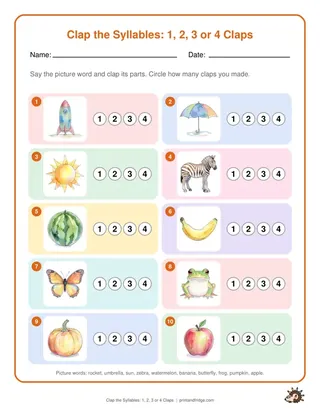
Ten picture words to clap out, from one clap to four: frog, sun, apple, rocket, pumpkin, zebra, banana, butterfly, umbrella and watermelon. Kids circle 1, 2, 3 or 4. The key shows each word split into its syllables. The answer key is on page 2. Big pictures and only a few tasks per page make it a gentle start for kindergartners.
-
6. Change the First Sound: Make a New Word
Six word pairs where only the first sound changes: cat to hat, pen to hen, log to dog, mug to rug, box to fox and sock to lock. Each row shows the old word and its picture, the letter swap, and the new picture with letter boxes where only the first box is empty. The answer key is on page 2. Big pictures and only a few tasks per page make it a gentle start for kindergartners.
-
7. Does the Word Match the Picture? Yes or No
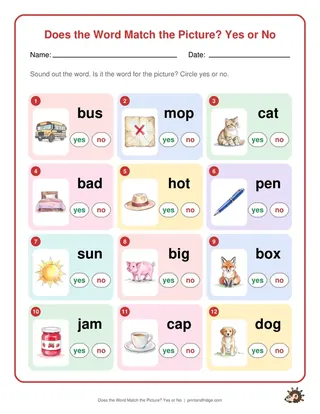
Twelve pictures, each with a three-letter word next to it. Six words are right (cat, sun, dog, bus, pen, jam) and six are one letter off (big for pig, bad for bed, cap for cup, hot for hat, box for fox, mop for map), so kids have to read every letter instead of guessing from the picture. The answer key is on page 2. It suits ages 4 to 6, and little ones can count the pictures with a finger.
-
8. Blend the Sounds: Write the Word, Find the Picture
Six blending cards: b + ug, h + at, p + ig, s + un, m + op and j + am. Kids push the first sound and the ending together, write the whole word, then choose between two pictures that start with the same sound (bug or bus, hat or hen, pig or pen). The answer key is on page 2. Big pictures and only a few tasks per page make it a gentle start for kindergartners.
Tips for parents and teachers
- Say every picture word out loud before the child starts; a picture can have two names (cup or mug).
- Stretch the word like a rubber band: sssuuunnn. Then let it snap back: sun.
- Do the listening pages with eyes closed first, then open the sheet.
Did you know?
- English has 26 letters but about 44 sounds.
- Hearing the separate sounds in spoken words (phonemic awareness) is one of the best early signs of later reading success.
Fun ways to use your printables
- Play I spy with sounds: I spy something that ends with t.
- Clap the names of everyone at the dinner table: Ma-ri-a has three claps.
How to print
Click Download PDF and print at 100% on US Letter or A4 paper. Page 1 is the worksheet and page 2 is the answer key, so choose “page 1” in the print dialog if you only want the practice page. Every worksheet is free for home, homeschool and classroom use, so print as many copies as you need.
Frequently asked questions
What phonics skills should a kindergartner know?
By the end of kindergarten most children can name the sound of each letter, hear the first and last sound in a short word, blend three sounds into a word (c-a-t, cat), clap syllables and rhyme. The review sheet checks the first four of these on one page.
Which sheet should we start with?
Start with Clap the Syllables: it only needs listening and clapping. Then do Where Is the Sound and Ending Sounds, then Count the Sounds. Blending and Change the First Sound come last, because they need letters too.
Why does the sound counting sheet say duck has three sounds?
Sounds are not letters. Duck has four letters but three sounds, d-u-ck, because c and k together make one sound. Fish works the same way with sh. Count what you hear, not what you see.
My child knows the letters but cannot blend. Is that normal?
Yes. Knowing that b says b is a different skill from pushing b and ug together. Say the parts slowly, then faster and faster until the word pops out. A few minutes every day works better than one long session.
Are these worksheets enough to teach reading?
No sheet is. They are short practice for skills you also do out loud: in the car, at dinner, on walks. Add simple books read together every day and the sheets do their job.