Kindergarten Letter Worksheets
Updated November 2026 · 8 free printables
Free printable kindergarten letter worksheets that work with the whole alphabet at once: 8 sheets for letter recognition, matching capital and small letters, ABC order, the b, d, p and q mix-up, an A to Z maze, a letter hunt inside real words and an alphabet cut and paste.
By signing up you agree to our privacy policy and to occasional emails with new printables. Unsubscribe any time.
Thank you! Your PDF is downloading. If it did not start, tap here to download it.


About these printables
They also suit preschool letter practice for four year olds who already know some letters.
The last sheet is a letter recognition check a parent or teacher can repeat every few weeks to see which letters still need work. 7 of the sheets have an answer key on page 2. For one letter at a time, the letter of the week pages (letter A to Z) have nine more sheets per letter.
At a glance
- Pages
- 8 free printables, one PDF each
- Ages
- 5 to 6
- Answer keys
- 7 of the 8 pages have one on page 2
- Paper
- US Letter and A4
- Complete pack
- all 8 pages in one PDF, free with an email sign-up
- Price
- free; every single page downloads with no sign-up
All 8 Kindergarten Letter Worksheets, One by One
Here is a closer look at every page in this collection: what it practices, which grade it fits and a tip for each one.
-
1. Match Uppercase and Lowercase Letters
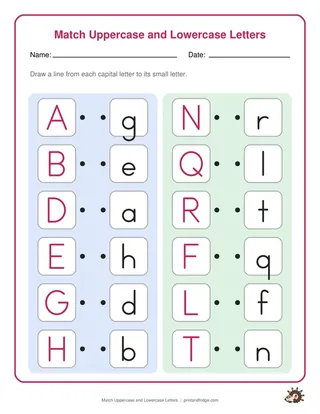
Twelve capital letters to match with their small letters, in two groups of six: A, B, D, E, G, H and N, Q, R, F, L, T. These are the pairs that look least alike (G and g, Q and q, R and r), so they are the ones kindergartners mix up most. The answer key is on page 2. Big pictures and only a few tasks per page make it a gentle start for kindergartners.
-
2. b, d, p or q? Find and Circle the Letter
Four rows for the four look-alike letters b, d, p and q. Each row has 16 letters made only of b, d, p and q; kids circle the six or seven that match the big letter and write how many they found. The answer key is on page 2. Big pictures and only a few tasks per page make it a gentle start for kindergartners.
-
3. ABC Order: What Letter Comes Next?
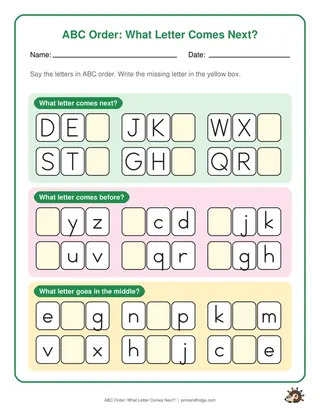
Eighteen little letter trains of three: six where the last letter is missing (what comes next), six where the first is missing (what comes before) and six where the middle one is missing. The first part uses capital letters, the other two use small letters. The answer key is on page 2. It suits ages 4 to 6, and little ones can count the pictures with a finger.
-
4. Alphabet Maze: Follow the Letters A to Z
A letter maze on a 6 by 7 grid of capital letters. Kids start at A in the corner and follow the alphabet in order, one box at a time, until they reach Z. There is only one way through, and the other 16 boxes hold letters that lead nowhere. The answer key is on page 2. Big pictures and only a few tasks per page make it a gentle start for kindergartners. Color the start and finish arrows in green and red.
-
5. Write the Partner Letter: Capital and Small
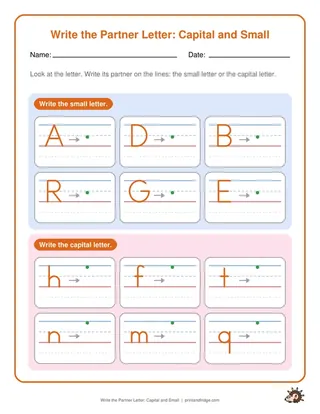
Twelve boxes with handwriting lines. In the first six the capital letter is given (A, B, D, E, G, R) and kids write the small letter from memory; in the last six the small letter is given (f, h, m, n, q, t) and they write the capital. Nothing to trace, so it shows which pairs a child really knows. The answer key is on page 2. Big pictures and only a few tasks per page make it a gentle start for kindergartners.
-
6. Kindergarten Letter Recognition Check
A one-page letter naming check for a parent or teacher: all 26 capital letters and all 26 small letters in mixed-up order, each with a small circle to check, plus a score out of 26 for each set and a line for the letters to practice. Use it at the start of the year and again every few weeks. Big pictures and only a few tasks per page make it a gentle start for kindergartners.
-
7. Letter Hunt: Find the Letter in Words
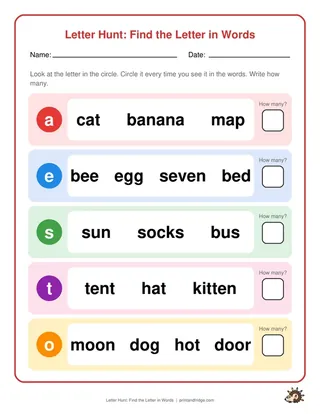
Five letter hunts inside real words: find a in cat, banana and map, e in bee, egg, seven and bed, s in sun, socks and bus, t in tent, hat and kitten, o in moon, dog, hot and door. Kids circle the letter each time and write the total, which is between four and six. The answer key is on page 2. It suits ages 4 to 6, and little ones can count the pictures with a finger.
-
8. Alphabet Cut and Paste: Missing Letters a to z
The whole lowercase alphabet in four rows, with ten letters missing. Kids cut out the ten letter tiles and glue them into the dashed boxes so that a to z is in order again. Scissors, glue and ABC order on one page. The answer key is on page 2. Big pictures and only a few tasks per page make it a gentle start for kindergartners.
Tips for parents and teachers
- Keep the letter recognition check in a folder and date it each time; children love seeing more circles checked.
- Name the letter and give its sound at the same time: B, b, ball.
- Practice only two or three new letters a week.
Did you know?
- Children usually learn the letters in their own name first.
- Most of the letters children meet in picture books are lowercase; capitals start sentences and names.
Fun ways to use your printables
- Put magnetic letters on the fridge and ask for one letter each morning.
- Cut the alphabet tiles from the cut and paste sheet a second time and play memory with capital and small pairs.
How to print
Click Download PDF and print at 100% on US Letter or A4 paper. Page 1 is the worksheet and page 2 is the answer key, so choose “page 1” in the print dialog if you only want the practice page. Every worksheet is free for home, homeschool and classroom use, so print as many copies as you need.
Frequently asked questions
How many letters should a kindergartner know?
Most US kindergartens expect children to name all 26 capital and all 26 small letters by the end of the year. Children start the year with very different counts; the recognition check shows where your child is today.
How do I use the letter recognition check?
Point to each letter in the mixed-up rows and ask its name. Check the circle when the answer is quick and right. Write the missing letters on the line at the bottom and repeat the check in three or four weeks.
Why are b, d, p and q so hard?
They are the same shape turned and flipped, and in real life an object stays the same when you turn it. Children need to learn that for letters, direction matters. Mix-ups are normal until about age seven.
Capital letters or small letters first?
Both, side by side. Most of what a child reads is in small letters, but capitals are easier to write and start every name. The matching and partner letter sheets practice the pairs together.
Are these the same as the letter of the week sheets?
No. The letter of the week pages focus on one letter each. These sheets mix the whole alphabet, which is what a child needs once most single letters are known.