Printable Brain Teasers for Kids
- Free PDFs, no signup
- 40 printables
- US Letter and A4
- Complete pack: all 40 pages in one PDF
- Updated November 2026
Printable brain teasers for kids in grades 1 to 5: riddles with answers, logic grid puzzles, matchstick puzzles where you move one stick to fix an equation, kid-size sudoku, picture logic nonograms, contest-style math questions and coding puzzles.
By signing up you agree to our privacy policy and to occasional emails with new printables. Unsubscribe any time.
Thank you! Your PDF is downloading. If it did not start, tap here to download it.
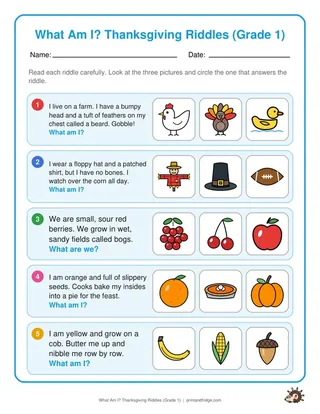
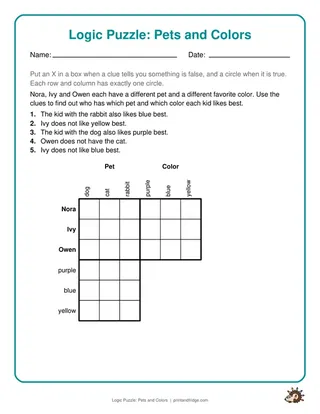
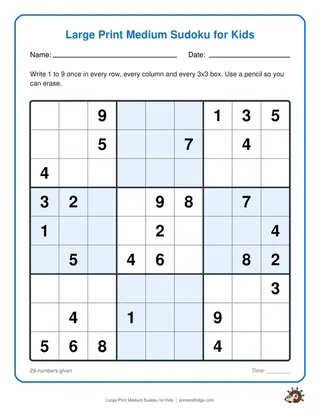
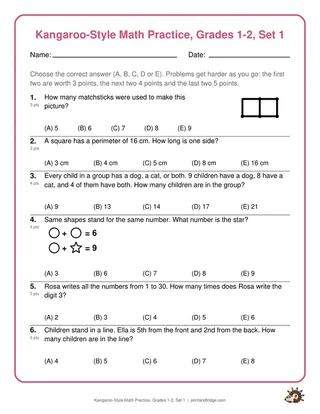


All 40 teasers in one PDF
No need to download them one by one. Type your email and the whole pack downloads right away.
By signing up you agree to our privacy policy and to occasional emails with new printables. Unsubscribe any time.
Thank you! Your PDF is downloading. If it did not start, tap here to download it.


Liked these? Take all 40 teasers in one PDF
One file, ready to print. Type your email and it downloads right away.
By signing up you agree to our privacy policy and to occasional emails with new printables. Unsubscribe any time.
Thank you! Your PDF is downloading. If it did not start, tap here to download it.
About these printables
They stretch thinking in a different way than regular worksheets, because the way to the answer is not shown.
Use them as a warm-up, a Friday challenge, a car activity or an early finisher task. Almost every page has the answers on page 2, and the difficulty is marked on each sheet, so you can match the teaser to the child. All are free PDFs for US Letter or A4.
At a glance
- Pages
- 40 free printables, one PDF each
- Ages
- 6 to 11
- Levels
- Easy, Medium, Hard, Grade 1, Grade 2, Grade 3, Grades 1-2
- Answer keys
- 38 of the 40 pages have one on page 2
- Versions
- 6 printable versions (A-F) of 4 of the 40 worksheets: same skill, new numbers, each with its own answer key
- Paper
- US Letter and A4
- Play online
- 14 of them also work as a free browser game
- Complete pack
- all 40 pages in one PDF (box at the top of this page)
- Price
- free; every single page downloads with no sign-up
Printable Brain Teasers for Kids, One by One
A closer look at the pages that belong to this collection itself. The other pages in the gallery above are described on their own theme pages, linked from each card.
-
1. Coding Maze: Follow the Pig and Count the Corn Cobs
The 6 by 6 board has the pig, two corn cobs and the barn, plus two rocks, a log and a fence in the way. Kids follow the printed code of 12 arrows, draw the path, circle the square where it ends, say whether the pig got to the barn and write how many corn cobs it collected. Farm animals make the board friendly for little coders. The key shows the pig's path, the end square and both answers. This board is also the level "Pig Collects Corn Cobs" in our free online coding game.
-
2. Grid Coding Worksheet: Bunny Collects Strawberries
A first grade coding puzzle with an order to it: the bunny visits both strawberries before it may stop at the carrot, while two rocks, a tree and a mushroom block some squares. There are 13 empty boxes, exactly the length of the shortest code, so a detour on the way to the carrot runs out of boxes. A yes or no line asks the child to test the bunny's code with a coin. A garden board with a hungry bunny. Page 2 gives one shortest code for the bunny in red with the path shaded, and other codes of the same length are also correct. This board is also the level "Bunny Collects Strawberries" in our free online coding game.
-
3. Debugging Worksheet: Fix the Code for the Bee
A debugging worksheet for 1st grade on a 6 by 6 board with two flowers to collect and two spiders, two spider webs and a rain cloud in the way. The printed code for the bee is right except for a single arrow; following it square by square shows where things go wrong. Kids circle the wrong arrow in the bee's code, write its step number, draw the arrow that fixes it and circle what went wrong. Our program checked that only one change fixes the bee's code. A sunny meadow where the bee heads home. This board is also the level "Bee Collects Flowers" in our free online coding game.
Tips for using brain teasers
- Read the teaser aloud and let the child restate it in their own words before solving.
- Give thinking time before any hint; the silence is part of the puzzle.
- Ask how they got the answer, not only what it is.
- Mix easy and hard teasers so every child gets some wins.
Fun facts about brain teasers
- Sudoku is short for a Japanese phrase that means the digits must remain single.
- Nonograms, the picture logic puzzles, were invented in Japan in 1987.
- Matchstick puzzles have appeared in puzzle books since the late 1800s.
Fun ways to use your printables
- Start the school day with a brain teaser on the board and reveal the answer at lunch.
- Let children write their own riddle for a classmate.
- Hold a Friday puzzle challenge with teams and a points table.
How to print
Click Download PDF and print at 100% on US Letter or A4 paper. 38 of the 40 pages come with an answer key (page 2 of their PDF; the page of each one says so), so choose “page 1” in the print dialog if you only want the practice page. Every page is free for home, homeschool and classroom use, so print as many copies as you need.
Frequently asked questions
What are good brain teasers for kids?
Puzzles that are easy to explain but need real thinking: riddles, logic puzzles, matchstick equations, sudoku, nonograms and short math reasoning questions. The best ones make a child say "oh!" when they see the answer.
Which brain teasers suit first and second graders?
Picture riddles, easy logic puzzles, 4 by 4 sudoku and the easy matchstick puzzles. Read the riddle aloud for children who are still learning to read.
Are brain teasers good for a child's thinking?
They practice reasoning, trying ideas and checking them, and not giving up after a wrong guess. Talk through the answer together afterwards; explaining it is half the benefit.
Do the brain teasers come with answers?
Yes. Almost every page has its answers on page 2 of the PDF; the facts box at the top of this page shows the exact count.