Cursive Letter Joins Worksheets
- Free PDFs, no signup
- 11 printables
- US Letter and A4
- Complete pack: all 11 pages in one PDF
- Updated November 2026
Free printable worksheets for connecting cursive letters, for second and third grade. Each page practises one family of joins: bottom joins into small letters (an, in, un), bottom joins up to tall letters (al, ck, it), the harder top joins after o, v, w and b (on, or, ve, wa, br), the digraphs sh, ch, th, wh and ph, l blends and r blends, vowel teams, double letters, word endings like ing, ed and ly, tricky joins with e, r and s, and capitals joined to the small letter that follows.
By signing up you agree to our privacy policy and to occasional emails with new printables. Unsubscribe any time.
Thank you! Your PDF is downloading. If it did not start, tap here to download it.


About these printables
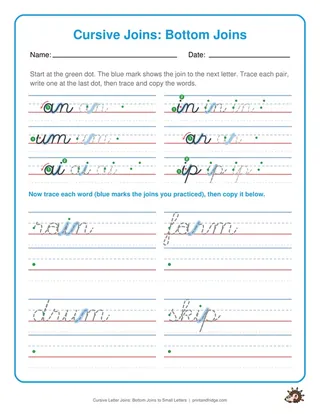
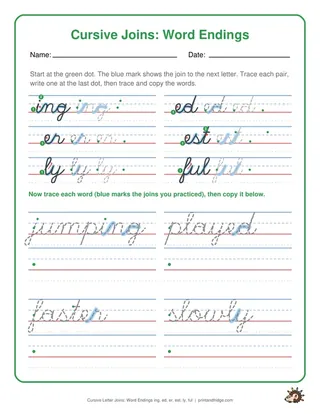
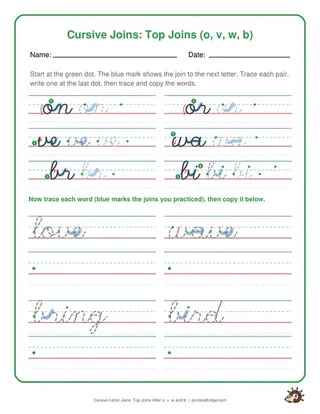
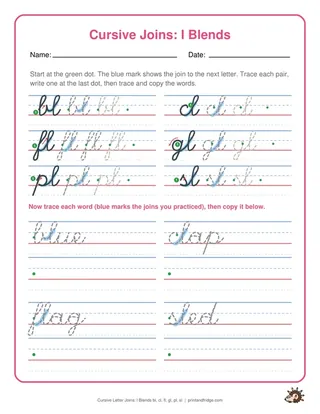
Every pair is shown big as a model with a green start dot and red arrows, and a light blue mark shows the joining stroke itself. Children trace dashed copies, write one from the start dots alone, then trace and copy four short words that use the same joins.
At a glance
- Pages
- 11 free printables, one PDF each
- Ages
- 7 to 9
- Levels
- Grade 2, Grade 3
- Paper
- US Letter and A4
- Complete pack
- all 11 pages in one PDF (box at the top of this page)
- Price
- free; every single page downloads with no sign-up
All 11 Cursive Letter Joins Worksheets, One by One
Here is a closer look at every page in this collection, with who it's best for and a coloring idea for each one.
-
1. Cursive Letter Joins: Bottom Joins to Small Letters
Practice the most common cursive join: the stroke that swings up from the bottom of one letter to the start of a small letter (an, in, um, ar, ai, ip). Each pair has a solid model with the join in color, dashed copies to trace and a dot to write it alone, then the words rain, farm, drum and skip to trace and copy. For grade 2 and 3. It fits second grade, around ages 7 to 8.
-
2. Cursive Letter Joins: Bottom Joins to Tall Letters
The join that climbs all the way to the top line: a, i and c joined to the tall letters l, b, k, t and d. Children trace al, il, ab, ck, it and ad with the connecting stroke shown in color, then write ball, duck, milk and kite twice. A grade 2 to 3 cursive practice sheet for tall loops. It fits second grade, around ages 7 to 8.
-
3. Cursive Letter Joins: Top Joins After o, v, w and b
Four cursive letters end high, at the midline: o, v, w and b. Their join runs straight across to the next letter instead of up from the bottom, the join children find hardest. Trace on, or, ve, wa, br and bi, then love, wave, bring and bird. For grade 2 and 3. Second graders usually finish it in 10 to 15 minutes.
-
4. Connecting Cursive Letters: Digraphs sh, ch, th, wh, ph
Two letters, one sound, one smooth join: sh, ch, th, wh, ph and ng in cursive, each with a solid model, dashed copies and a dot to write it alone. Then trace and copy ship, chick, thumb and whale. Links phonics and cursive for grade 2 and 3. Second graders usually finish it in 10 to 15 minutes.
-
5. Cursive Letter Joins: l Blends bl, cl, fl, gl, pl, sl
Six l blends in joined cursive: bl, cl, fl, gl, pl and sl. Every pair ends with the tall loop of l, so children practice reaching the top line without lifting the pencil. Then blue, clap, flag and sled to trace and copy. Grade 2 and 3. Second graders usually finish it in 10 to 15 minutes.
-
6. Cursive Letter Joins: r Blends cr, dr, fr, gr, pr, tr
Cursive r is one of the trickiest letters to join into. This sheet practices cr, dr, fr, gr, pr and tr with the joining stroke in color, then the words crab, drum, frog and tree to trace and copy on handwriting lines. For grade 2 and 3. It fits second grade, around ages 7 to 8.
-
7. Cursive Letter Joins: Vowel Teams ee, ea, oa, oo, ou, ay
Two vowels joined together: ee, ea, oa, oo, ou and ay in cursive. The pairs that start with o use the high top join, the others the bottom join, so children practice both. Then seat, boat, moon and play to trace and copy. Grade 2 and 3. Second graders usually finish it in 10 to 15 minutes.
-
8. Connecting Cursive Letters: Double Letters ll, ss, tt, ff, pp, dd
Double letters in joined cursive: ll, ss, tt, ff, pp and dd. Writing the same letter twice in one movement builds even size and spacing. Then bell, dress, kitten and puppy to trace and copy. For grade 2 and 3. It fits second grade, around ages 7 to 8.
-
9. Cursive Letter Joins: Word Endings ing, ed, er, est, ly, ful
The endings children write most often, joined in cursive: ing, ed, er, est, ly and ful. Each ending has a model with numbered starts and colored joins, dashed copies and a dot to write it alone. Then jumping, played, faster and slowly. Grade 2 and 3. It is aimed at third grade, around ages 8 to 9.
-
10. Cursive Letter Joins: Tricky e, r and s Joins
The joins that turn messy most often: e, r and s next to each other (re, er, se, es, rs) and the high join of or. Children trace each pair with the connecting stroke in color, then three, rose, horse and eraser. A grade 2 to 3 cursive practice sheet. It is aimed at third grade, around ages 8 to 9.
-
11. Connecting Cursive Letters: Capital to Small Letter Joins
How a cursive capital joins the small letter after it: An, Ch, Em, Ja, Lu and Ru with the join in color, then four names to trace and copy (Anna, Emma, Jack and Ruby). Only capitals that join are shown: B, D, F, O, P, V, W and X stay apart from the next letter. Good practice for writing names in cursive, grade 3. It is aimed at third grade, around ages 8 to 9.
Tips for coloring Cursive Letter Joins Worksheets
- Trace each pair slowly the first time and keep the pencil on the paper from the first letter to the end of the second.
- Look at the blue mark before tracing: it shows exactly where one letter hands over to the next.
- If a top join (o, v, w, b) comes out too low, practise the bottom join page again, then come back.
Fun facts about Cursive Letter Joins Worksheets
- Joined handwriting grew out of scribes wanting to write faster: every time the pen stays down, a little time is saved.
- In most cursive styles a word is written in one stroke, and i dots and t crosses are added at the very end.
- School cursive styles differ: some join most capitals to the next letter, others leave capitals such as B, D and O unjoined.
Fun ways to use your printables
- Write the family's names in cursive and circle every join that appears on the join pages.
- Turn a join into a race: how many smooth "on" pairs can you write in one minute without lifting the pencil?
- Hunt for the practised joins in a birthday card or a recipe written by hand.
How to print
Click Download PDF on any page and print it at 100% on US Letter or A4 paper. Use regular printer paper for crayons and pencils, or cardstock for markers and paint. Every page here is free for home, classroom and party use, so feel free to print as many copies as you need.
Frequently asked questions
Why practise letter joins on their own?
Most cursive mistakes happen between letters, not inside them: the pen lifts, the join starts too low or the next letter loses its shape. Practising the joining stroke in pairs makes whole words smoother.
Which joins are the hardest?
The top joins after o, v, w and b, because the stroke leaves the letter high at the midline instead of from the baseline. Do the bottom join pages first, then the top joins.
Do capital letters join the next letter?
Many school styles join most capitals (Al, Ch, Em) but leave a few unjoined. Our capital joins page follows the cursive font used on all our sheets; if your school's style lifts after a capital, simply lift there.