Teaching Kids to Count and Add with Printables (K-2)
Early math is built in layers. Children need to count reliably before they can add, and they need to understand what addition means before memorizing facts. Printables can help at every layer, as long as you use them in the right order. Here's a simple path from first counting to adding within 20.
Step 1: counting objects, not just numbers
Many children can recite “1, 2, 3...” long before they understand that each number matches one object. Start with one-to-one counting: touching each item once while saying one number.
Try this: give your child a counting worksheet with pictures of apples, stars or animals. Have them point to each picture as they count, then write or circle the total.
Watch for: skipping items, counting one twice, or not being able to say how many there are after counting. All of these are normal and improve with practice.
Step 2: number recognition and writing
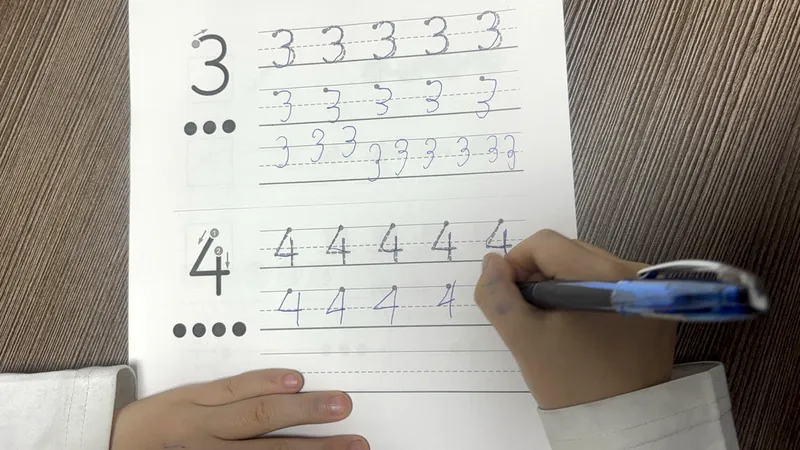
Once counting is steady, connect quantities to written numbers. Number tracing worksheets help children learn how each digit is formed. Practice 1 to 10 first, then move to 20.
Tip: reversed digits (like a backward 3 or 7) are common in young writers. Gently show the correct way and keep going.
Step 3: understanding “more” and “less”
Before adding, children should be able to compare groups. Use comparing numbers worksheets that ask “which group has more?” Real objects, like coins, blocks or snacks, make this even clearer.
Step 4: adding with pictures
Now introduce addition as putting groups together. Start with picture problems: 3 ducks plus 2 ducks. Have your child count all the ducks to find the total. The first addition worksheets work exactly this way.
Use real objects too. Grab buttons or building bricks and act out each problem before writing the equation. This links the physical idea to the symbols.
Step 5: adding with numbers and strategies
When picture addition feels easy, move to written equations such as 4 + 3. Teach a few simple strategies instead of drilling:
- Count on. Start with the bigger number and count up. For 6 + 2, say “6... 7, 8.”
- Doubles. Knowing 3 + 3 and 5 + 5 helps with near-doubles like 3 + 4.
- Make ten. For 8 + 5, think 8 + 2 = 10, then add the other 3. Number bonds practice exactly this.
- Number line. Hop forward along a printed number line to see addition happen.
Keeping practice fun
Worksheets alone can get dull, so mix in:
- Dice games. Roll two dice and add them. First to reach 50 wins.
- Card war. Each player flips two cards and adds them. Highest sum takes the cards.
- Number hunt. Find the number of the day around the house or on a walk.
- Color by number. An addition color by number turns ten sums into a picture.
Our online number game also gives extra practice: every question is read aloud, and a wrong answer is counted out step by step.
How much practice is enough?
Ten to fifteen minutes a day is a good target for most K-2 children. If your child gets frustrated, stop and come back later. A short, positive session is better than a long, tearful one.
When to check in with a teacher
If your child still struggles with counting to 10 at age 6, or doesn't seem to improve with steady practice, talk with their teacher. Teachers can tell you what skills the class is working on and whether extra support would help.
Frequently asked questions
Should my child memorize addition facts?
Eventually yes, but understanding comes first. Strategies like doubles and make-ten make memorizing much easier later on.
Are answer keys important?
They save time and let you check work quickly. Most of our math worksheets have one on the last page. Try having your child check their own work to build independence.
What if my child counts on their fingers?
That's a normal and useful strategy at this age. Over time, most children shift to mental strategies naturally.
Ready to practice?
Start with counting worksheets or jump to addition worksheets. Print a few pages, grab some snacks to count, and have fun with it.

I'm Basil, a parent who has been making worksheets for children since I was nine, when my first student was my three-year-old sister. I started Print & Fridge to share the sheets I make for my own kids. Read the whole story →


