Valentine's Day Math Worksheets (Pre-K to 3rd Grade)
- Free PDFs, no signup
- 14 printables
- Answer keys included
- US Letter and A4
- Complete pack: all 14 pages in one PDF
- Updated November 2026
Fourteen Valentine's Day math pages that climb from counting to multiplication: ten frames full of hearts and an I spy counting game for preschool; picture addition and subtraction within 10 and a more-or-fewer candy page for kindergarten; heart number bonds to 10, a Make 14 puzzle for February 14 and a candy heart picture graph for first grade; skip counting heart chains, a valentine shop with US coins, chocolate box fractions and two-digit word problems for second grade; and multiplication and division word problems plus a class party math story with five linked questions for third grade.
By signing up you agree to our privacy policy and to occasional emails with new printables. Unsubscribe any time.
Thank you! Your PDF is downloading. If it did not start, tap here to download it.


About these printables
Every page has an answer key on page 2, with the answers in red. If your child likes math with coloring, the Valentine color by number pages on the main Valentine's Day worksheets page hide hearts and flowers behind addition and subtraction facts.
At a glance
- Pages
- 14 free printables, one PDF each
- Ages
- 3 to 9
- Levels
- Pre-K to Grade 3
- Answer keys
- on page 2 of every PDF
- Paper
- US Letter and A4
- Complete pack
- all 14 pages in one PDF (box at the top of this page)
- Price
- free; every single page downloads with no sign-up
All 14 Valentine's Day Math Worksheets (Pre-K to 3rd Grade), One by One
Here is a closer look at every page in this collection, with who it's best for and a coloring idea for each one.
-
1. Valentine's Day Ten Frames: Count the Hearts
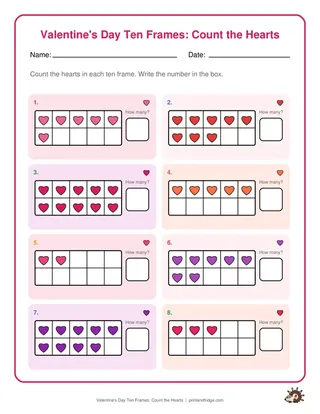
Eight ten frames filled with colorful hearts, from 2 hearts up to a full frame of 10. Preschoolers and kindergartners count the hearts in each frame, see how many squares are still empty and write the number in the box. Every frame fills row by row, the way ten frames are taught in early math. Answer key on page 2. It is made for pre-K and preschool, roughly ages 4 to 5, with big pictures and one number per page. Add patterns inside the hearts.
-
2. Valentine I Spy Counting: Count the Party Treats
A busy party picture full of Valentine treats: hearts, balloons, cupcakes, lollipops, gifts and envelopes, tumbled in every direction. Children look for one kind at a time, count it and write the number in the box beside its picture; every kind appears a different number of times, from 1 to 6, so 21 pictures in all. A quiet counting game for preschool and kindergarten. Answer key on page 2. It is made for pre-K and preschool, roughly ages 4 to 5, with big pictures and one number per page. Add patterns inside the hearts.
-
3. Valentine Picture Addition Within 10
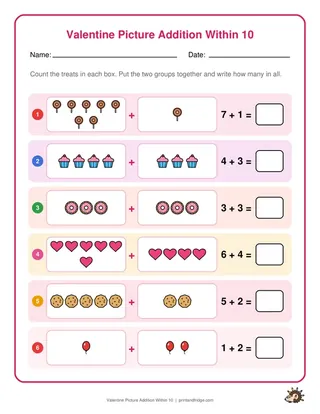
Six picture addition problems with sums up to 10. Each problem shows two boxes of Valentine treats (hearts, cupcakes, lollipops, balloons, cookies or candies) and the number sentence beside them, so kindergartners count the first group, count on through the second and write the total. The pictures sit in neat rows of five to make counting easier. Answer key on page 2. Big pictures and only a few tasks per page make it a gentle start for kindergartners. Add patterns inside the hearts.
-
4. Valentine Picture Subtraction: Cross Out and Count
Eight take-away problems within 10 with Valentine treats. The first card is a worked example; on the other seven the child reads the number sentence, crosses out that many hearts, balloons, cupcakes or cookies and counts the ones that are left. Crossing out by hand connects the minus sign to taking away, the key skill of kindergarten subtraction. Answer key on page 2 shows the crossed-out pictures. Big pictures and only a few tasks per page make it a gentle start for kindergartners. Add patterns inside the hearts.
-
5. Valentine More or Fewer: Compare the Candy
Comparing groups for kindergarten with Valentine candy, cookies and lollipops. In Part A the child counts two boxes and circles the one with MORE or the one with FEWER, as the heart beside the row says, so they have to read the word and not just pick the bigger pile. Part B compares three boxes: circle the most and the least. Answer key on page 2. Big pictures and only a few tasks per page make it a gentle start for kindergartners. Add patterns inside the hearts.
-
6. Valentine Heart Number Bonds to 10
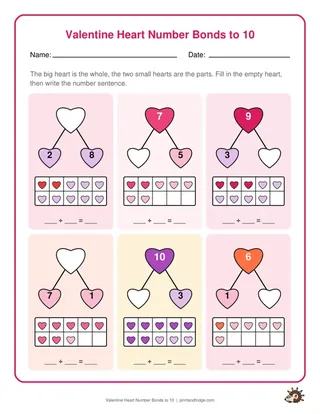
Six number bonds made of hearts: the big heart on top holds the whole, the two small hearts below hold the parts. On every bond one heart is empty (sometimes the whole, sometimes a part), and a ten frame of dark and light hearts under it shows the two parts as counters. First graders fill the empty heart and write the number sentence. Answer key on page 2. It matches first grade goals, roughly ages 6 to 7. Add patterns inside the hearts.
-
7. Make 14 for February 14: Valentine Heart Pairs
A February 14 number puzzle: twelve numbered hearts sit around one big heart, and ten of them make five pairs that add up to 14 (one pair is a double). First graders find the partners, color each pair in its own color, write the five number sentences and name the two hearts that have no partner. Good practice for addition facts within 20 and making ten. Answer key on page 2. First graders can do it on their own once they know the strategy at the top of the page. Pink, red and purple are perfect for Valentine's Day.
-
8. Valentine Candy Heart Picture Graph
A bag of candy hearts in five colors (pink, purple, yellow, green and orange), 2 to 9 of each, scattered so children count carefully. First graders color one heart per candy in a picture graph with a row for each color, then answer five questions: how many of one color, which color has the most and the fewest, how many more, and how many in all. The key shows the colored graph and every answer. First graders can do it on their own once they know the strategy at the top of the page. Pink, red and purple are perfect for Valentine's Day.
-
9. Valentine Skip Counting Heart Chains: 2s, 5s, 10s
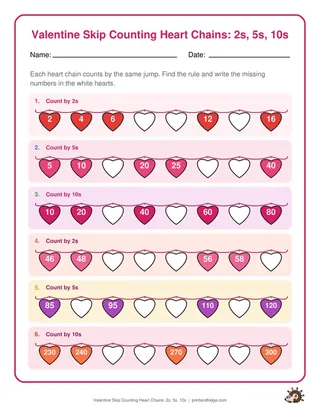
Six heart garlands for skip counting: by 2s, 5s and 10s from the start, then the same jumps from harder numbers (46, 85 and 230). Three or four hearts on every chain are empty, sometimes two in a row, so second graders find the rule from the filled hearts and count on to fill the gaps. Answer key on page 2. It fits second grade, around ages 7 to 8. Add patterns inside the hearts.
-
10. Valentine Shop Money Worksheet: Count the Coins
A Valentine shop with six price tags: cupcakes, lollipops, balloons, gifts, cookies, flowers and more. Next to each treat is a wallet of pennies, nickels, dimes and quarters; second graders count the coins, write the total in cents and circle YES if it is enough to buy the treat or NO if it is not. Half the wallets are just a little short, so careful counting matters. Answer key on page 2. It fits second grade, around ages 7 to 8. Add patterns inside the hearts.
-
11. Valentine Fractions: Chocolate Boxes and Cookies
Fractions with Valentine treats: boxes of chocolates split into equal compartments and round cookies cut into equal slices, in halves, thirds and fourths. In Part A second graders count the parts with a chocolate heart or pink frosting and write the fraction; in Part B they color one third of a box, three fourths of a cookie and two fourths of a box, with the fraction words printed underneath. Answer key on page 2. Second graders usually finish it in 10 to 15 minutes. Pink, red and purple are perfect for Valentine's Day.
-
12. Valentine Class Party Word Problems (Grade 2)
Six class party story problems for second grade with two-digit numbers: paper hearts for the classroom, valentine stickers, cupcakes, friendship cards, candy hearts left in the jar and balloons that popped. Three stories add and three subtract, mixed up, so children read for the question instead of guessing the operation; each card has a box to show the work. Answer key on page 2 with the number sentences. Second graders usually finish it in 10 to 15 minutes. Pink, red and purple are perfect for Valentine's Day.
-
13. Valentine Multiplication and Division Word Problems
Six Valentine's Day story problems for third grade: candy hearts for friends, trays of cupcakes, stickers on cards, rows of balloons, valentines shared among mailboxes and students at party tables. Three multiply and three divide with facts from the 3 to 9 times tables, every division comes out even, and each problem asks for the number sentence as well as the answer. Answer key on page 2. Third graders can use it for practice, review or a quick check before a test. Pink, red and purple are perfect for Valentine's Day.
-
14. Valentine's Day Class Party Math Story (Grade 3)
One Valentine's Day class party story with five linked questions, the word-problem format used in many third-grade programs: cupcakes on trays, the students at each table and bags of candy hearts shared equally. Children multiply, subtract and divide using numbers from the story (and from earlier answers), show their work and answer in full sentences. The answer key gives every number sentence and sentence answer. It is aimed at third grade, around ages 8 to 9. Add patterns inside the hearts.
Tips for coloring Valentine's Day Math Worksheets (Pre-K to 3rd Grade)
- Let young children touch each heart as they count; on the ten frames, count the empty squares too.
- Use real candy hearts or buttons as counters for the picture addition and subtraction pages.
- Read word problems aloud together and ask "will the answer be bigger or smaller?" before choosing an operation.
Fun facts about Valentine's Day Math Worksheets (Pre-K to 3rd Grade)
- Ten frames show 10 as two rows of 5, which helps children see 7 as 5 and 2 without counting one by one.
- Number bonds (parts and whole) are the same idea as fact families: 6 + 4 = 10 and 10 - 4 = 6.
- A box of 12 chocolates can be shared fairly by 2, 3, 4 or 6 friends, which makes it a handy fractions model.
Fun ways to use your printables
- Count the valentines your child brings home and make a tally chart by who sent them.
- Set up a pretend valentine shop with real coins and price tags from 5 to 50 cents.
- Bake cupcakes and ask how many trays of 6 you need for the whole class.
How to print
Click Download PDF on any page and print it at 100% on US Letter or A4 paper. Use regular printer paper for crayons and pencils, or cardstock for markers and paint. Every page here is free for home, classroom and party use, so feel free to print as many copies as you need.
Frequently asked questions
Which Valentine's Day math worksheet should my child start with?
Pre-K: ten frames, then the I spy counting game. Kindergarten: picture addition, picture subtraction and more or fewer. First grade: number bonds, Make 14 and the candy heart graph. Second grade: skip counting, the valentine shop, fractions and the grade 2 word problems. Third grade: the grade 3 word problems and the class party math story, which asks for full-sentence answers.
What is the February 14 page?
A sum puzzle for first grade: every heart holds a number, and children color the pairs of hearts that add up to 14, the date of Valentine's Day. The key on page 2 shows each pair.
Can I print these for my whole class?
Yes. Every sheet is a free PDF without sign-up, for home, homeschool and classroom use, and you can print as many copies as your class needs. Please do not sell them or upload the files to another website; linking to this page is always fine.