Free Printable Valentine's Day Worksheets
- Free PDFs, no signup
- 44 printables
- US Letter and A4
- Complete pack: all 44 pages in one PDF
- Updated November 2026
Valentine's Day worksheets for children from preschool to third grade (about ages 3 to 9), free to download as PDFs on US Letter paper, no account needed.
By signing up you agree to our privacy policy and to occasional emails with new printables. Unsubscribe any time.
Thank you! Your PDF is downloading. If it did not start, tap here to download it.


About these printables
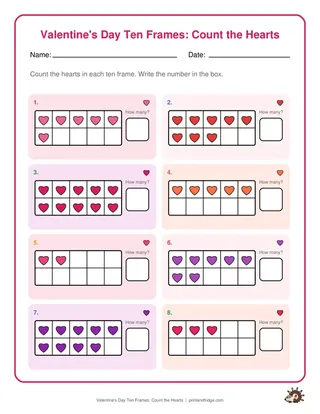
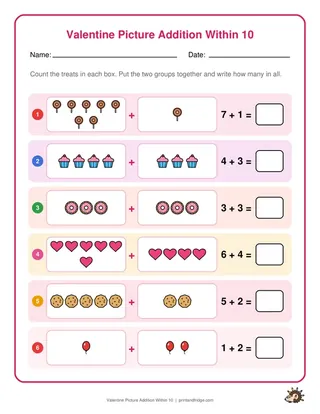
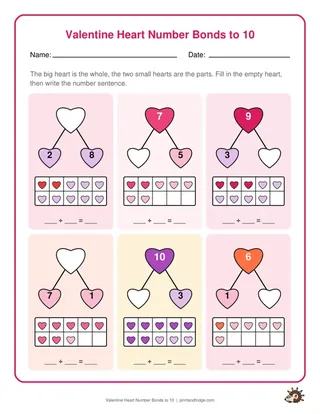
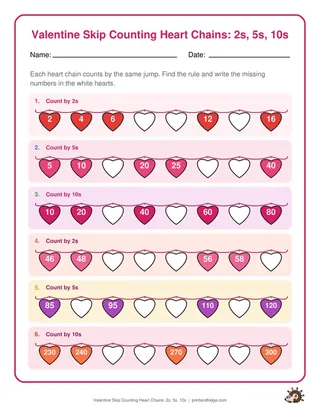
The 31 new sheets were made for this page: 14 math pages (ten frames, an I spy counting game, picture addition and subtraction, more or fewer, number bonds, a Make 14 heart puzzle for February 14, a candy heart graph, skip counting, a valentine shop with coins, fractions, word problems for grades 2 and 3 and a class party math story), 11 reading and word pages (tracing lines, tracing words, beginning sounds, rhymes, syllables, ABC order, missing letters, a word scramble, a picture crossword, spelling words and a short kindness story with questions), 3 writing pages (acrostic poems, writing prompts, valentine words in cursive), a maze, kindness coupons and friendship cards.
Twenty-four sheets have an answer key on page 2 of the PDF; the writing pages, coupons and cards do not need one. The pictures are in color, but every page prints well in black and white. Further down you will also find our earlier Valentine puzzles: color by number, bingo cards, tic tac toe, a word search, bookmarks and dot to dot, 44 pages in all.
At a glance
- Pages
- 44 free printables, one PDF each
- Ages
- 3 to 9
- Levels
- Easy, Pre-K, Kindergarten, Grade 1, Grade 2, Grade 3
- Answer keys
- 25 of the 44 pages have one on page 2
- Paper
- US Letter and A4
- Play online
- 4 of them also work as a free browser game
- Complete pack
- all 44 pages in one PDF (box at the top of this page)
- Price
- free; every single page downloads with no sign-up
Free Printable Valentine's Day Worksheets, One by One
A closer look at the pages that belong to this collection itself. The other pages in the gallery above are described on their own theme pages, linked from each card.
-
1. Valentine's Day Tracing Lines for Preschool
Six dashed tracing lines for little hands, one Valentine's Day delivery on every row: mail the card (a straight line), fly the bee to the tulip (waves), float the balloon to the heart (zigzag), bring the gift to the teddy bear (arches), loop the butterfly to the flower and share the cookie with a mouse (steps). Each line starts at a green dot. Pre-writing practice for preschool and pre-K; no answer key needed. It is made for pre-K and preschool, roughly ages 4 to 5, with big pictures and one number per page. Add patterns inside the hearts.
-
2. Trace Valentine's Day Words with Pictures
Eight Valentine's Day words to trace in the ball-and-stick letters kindergarten classes teach: heart, card, gift, rose, candy, hug, friend and cake. Every word has its own colored picture and three copies on handwriting lines: a dark dashed word, a lighter one, and start dots only, so the last copy is written almost alone. Tracing practice, no answer key needed. Big pictures and only a few tasks per page make it a gentle start for kindergartners. Add patterns inside the hearts.
-
3. Valentine's Day Beginning Sounds: Circle the First Letter
Twelve colored Valentine's Day pictures (heart, gift, cupcake, teddy bear, lollipop, mailbox, flower, rose, star, tulip, puppy and penguin), each with three lowercase letters inside little hearts. Children say the picture name, listen for the first sound and circle the matching letter; the wrong letters change from card to card. A kindergarten phonics check for February. Answer key on page 2. It suits ages 4 to 6, and little ones can count the pictures with a finger. Pink, red and purple are perfect for Valentine's Day.
-
4. Valentine Rhyming Words: Match the Rhymes
Eight Valentine words with pictures on the left (heart, card, bee, rose, teddy bear, star, cake and a cocoa mug) and eight rhyming words mixed up on the right: cart, yard, tree, nose, chair, car, lake and hug. First graders read both columns, listen for the same ending sound and draw matching lines; a bonus box asks for their own rhymes for pink, sweet and kind. Answer key on page 2. It matches first grade goals, roughly ages 6 to 7. Add patterns inside the hearts.
-
5. Valentine's Day Syllables: Clap and Color the Hearts
Twelve Valentine's Day pictures to clap into syllables: heart, gift, rose and star have one clap; cupcake, candy, mailbox and tulip have two; lollipop, butterfly, envelope and teddy bear have three. Each card shows the word in manuscript letters and three empty hearts, and children color one heart per clap. A phonological awareness page for first grade. The key colors the right number of hearts. It matches first grade goals, roughly ages 6 to 7. Add patterns inside the hearts.
-
6. Valentine's Day ABC Order: Sort the Valentine Mail
Ten Valentine words written on envelopes, each with a little picture: bear, candy, flower, gift, heart, lollipop, mailbox, rose, star and tulip. First graders put the mail in alphabetical order on ten numbered hearts; every word starts with a different letter. A challenge box adds cookie, card, cupcake and chocolate, sorted by the second letter. Answer key on page 2. First graders can do it on their own once they know the strategy at the top of the page. Pink, red and purple are perfect for Valentine's Day.
-
7. Valentine Missing Letters: Complete the Words
Ten Valentine words with one letter missing: he_rt? No, hea_t! Each card has a colored picture (heart, card, gift, rose, teddy bear, star, cake, candy, cocoa mug and tulip), the word in letter tiles with one pink box empty, and a line to write the whole word. The word bank at the top helps first graders check their spelling. Answer key on page 2. First graders can do it on their own once they know the strategy at the top of the page. Pink, red and purple are perfect for Valentine's Day.
-
8. Valentine's Day Word Scramble with Word Bank
Twelve Valentine's Day words with their letters mixed up in tiles: FRIEND, HEART, CANDY, SHARE, FLOWER, SWEET, PARTY, COOKIE, BALLOON, SMILE, LETTER and KIND. No scramble starts with the right letter or spells another word, and the word bank at the top lets second graders check their spelling while they solve. Answer key on page 2. Second graders usually finish it in 10 to 15 minutes. Pink, red and purple are perfect for Valentine's Day.
-
9. Valentine's Day Picture Crossword Puzzle
A Valentine's Day crossword with eight picture clues instead of written ones: balloon, envelope, candy, cookie, rose, gift, lollipop and heart. Every clue card has its number and an arrow for across or down, and a word bank at the bottom helps second graders spell the longer words. The grid is checked so all crossings share the same letter. Answer key on page 2. It fits second grade, around ages 7 to 8. Add patterns inside the hearts.
-
10. Valentine's Day Spelling Words: Look, Say, Cover, Write, Check
Ten second-grade Valentine spelling words (heart, friend, card, share, kind, candy, sweet, party, flower and happy) in a look, say, cover, write, check table: read the word, cover it, write it from memory, write it again and color a heart for every word spelled right. Four fill-in sentences at the bottom use the words in context. Answer key on page 2. Second graders usually finish it in 10 to 15 minutes. Pink, red and purple are perfect for Valentine's Day.
-
11. The Kindness Card: Valentine's Day Reading Comprehension
An original 119-word story for first grade: Mia sees that Sam, the new boy, sits alone, so she makes him a Valentine card with a little dog on it and asks him to play tag. Four questions follow: two multiple choice, putting three events in order, and a written answer with the sentence starter "Mia was kind because she...". Answer key on page 2. It matches first grade goals, roughly ages 6 to 7. Add patterns inside the hearts.
-
12. Valentine Acrostic Poems: LOVE and FRIEND
Two acrostic poems on one page: LOVE down the left and FRIEND down the right, every letter in a big heart with a line beside it. Second graders write a word or a short phrase for each letter (L for laugh, F for fun) with help from a word bank of ideas, then decorate their poems. A sweet Valentine's Day writing page about friendship. It fits second grade, around ages 7 to 8. Add patterns inside the hearts.
-
13. Valentine's Day Writing Prompts with Sentence Starters
Three Valentine's Day writing prompts for first grade, each with a sentence starter to trace on handwriting lines, two lines to finish it and a box to draw in: My friend is special because..., I can be kind to someone by... and My Valentine card will say... An idea bank (kind, funny, shares, helps, plays) helps beginning writers finish the sentence on their own. It matches first grade goals, roughly ages 6 to 7. Add patterns inside the hearts.
-
14. Valentine Words in Cursive: Trace and Write
Eight Valentine's Day words in joined cursive (heart, friend, kind, share, sweet, candy, party, smile), each on handwriting lines with a dashed word to trace from the green start dot and room to write it again. The bottom panel has the sentence "Be kind to your friends." to trace and two empty guides to copy it. Cursive practice for third grade. It is aimed at third grade, around ages 8 to 9. Add patterns inside the hearts.
-
15. Valentine's Day Maze: Deliver the Card to the Mailbox
An 8 by 9 Valentine's Day maze for kindergarten: lead the Valentine card from the top through the paths to the mailbox at the bottom. Little hearts sit along the way (some on dead ends), and a bonus question asks how many are on the right path. The answer key shades the whole solution path in pink with the hearts to count. It suits ages 4 to 6, and little ones can count the pictures with a finger. Pink, red and purple are perfect for Valentine's Day.
-
16. Valentine Kindness Coupons to Color and Cut Out
Eight kindness coupons for Valentine's Day to color, cut out and give to family or friends: one big hug, I help you clean up, I read you a story, we play your favorite game, I share my snack, I make you smile, I help set the table and I draw you a picture. Each coupon has a picture to color and To and From lines. Easy enough for kindergarten; no answer key needed. Big pictures and only a few tasks per page make it a gentle start for kindergartners. Add patterns inside the hearts.
-
17. Valentine Friendship Cards to Color, Cut and Fold
Two fold-in-half Valentine cards for friends: the front of each card has hollow letters (Happy Valentine's Day!) and a frame of little hearts with pictures to color (a heart, balloon, flower and lollipop; a cupcake, gift, star and candy); the back has To and From lines and a message to trace in dashed letters: You are a great friend! and Thank you for being kind. Cut, fold on the gray line with the pictures outside and write a note on the blank inside. For first grade; no answer key needed. It matches first grade goals, roughly ages 6 to 7. Add patterns inside the hearts.
-
18. Heart Balloons Color by Number
Five heart balloons, each a different color, rise from a bow at the bottom of the page with two clouds and a strip of grass. Every balloon is one big space, two red, one orange, one purple and one pink, and the sky around them is light blue (5) in five spaces, which is where most of the crayon time goes. The bow is yellow, the clouds are white and the grass is green. There are 16 spaces, eight crayons in the key and almost no small areas, so a three-year-old can do it alone in about ten minutes. It is a natural Valentine's Day page.
-
19. Heart Balloons Addition Color by Number
Eighteen problems and fourteen different facts fit on this small page, and nine of the spaces are sky, all problems that make 10, like 5+5, 4+6 and 2+8. Each balloon has its own sum and its own color: 8 is red, 7 is green, 6 is white, 4 is orange, 3 is purple and 2 is pink, and the bow at the bottom is yellow from 9. The three tiny knots on the strings are pre-numbered. With 21 spaces and no fiddly areas, a kindergartner finishes in ten to fifteen minutes. It makes a quick Valentine's Day math page, and the finished balloons can be cut out and glued onto a card.
-
20. Heart Balloons Subtraction Color by Number
Nine sky spaces all equal 1, and five of them are the very same problem, 7-6, which is a quirk a child will spot and enjoy. Each balloon has one problem and one color: 10-7 makes 3 for the red heart, 9-5 and 5-4 give the others, and the bow is yellow from 7-5. Eighteen problems with thirteen different facts fill 21 spaces, with three tiny string knots pre-numbered. Minuends run from 4 to 10. Eight crayons are listed. This is a ten-minute page for first graders and for kindergartners who are just starting subtraction, with big spaces and no fine detail, and it suits Valentine's Day.
-
21. Heart Pixel Color by Number
Three crayons and a grid: 84 squares marked 1 become a red heart, 57 squares marked 2 become the light blue background and two squares marked 3 are pink highlights on the heart's shoulder. The grid is 13 columns by 11 rows, the numbers are printed large in every cell, and a Name and Date line sits underneath. Because there are only three numbers to tell apart, it is a true first mystery picture for a three- or four-year-old, and the heart shape shows after the first few rows. Fifteen minutes of steady coloring finishes it. Square by square coloring also builds the left-to-right habit that reading needs.
-
22. Flower Pixel Color by Number
Fifty-one pink squares make a round flower head, eleven yellow squares the center, thirteen green squares the stem and two leaves, and 94 light blue squares the sky, more than half the grid. The page is 13 by 13, 169 squares, with four colored dots in the key at the top. The stem is a single column of green running down the middle of the lower half, a nice clear line for a child to follow. Four- and five-year-olds take about twenty minutes; the sky is the long part. A spring or Mother's Day page, and the finished flower cuts out neatly along the squares.
-
23. Heart Pixel Addition Color by Number
Every square holds a small problem, but only twelve different facts appear, all with sums of 3, 5 or 7: 2+5, 6+1 and 4+3 make the 84 red squares of the heart, 2+3 and 4+1 make the 57 light blue background squares, and 1+2 marks the two pink shine squares. Addends never go above 6. The grid is 13 by 11 with the three-color key at the top. Because the same few facts repeat, a kindergartner who starts by counting fingers is answering from memory by the bottom rows, which is the point of a pixel page. Allow twenty minutes. The heart shows after about four rows.
-
24. Flower Pixel Addition Color by Number
Ninety-four squares make 9 and turn light blue for the sky, 51 squares make 7 and turn pink for the petals, thirteen make 5 for the green stem and leaves and eleven make 4 for the yellow center. Twenty different facts appear with addends from 1 to 8. Four crayons cover the whole 13 by 13 grid. Four colors and one dominant sum make it a page a kindergartner can do mostly alone, about twenty-five minutes, with the sky as a long calm stretch of 9s at the end. The stem is a single column of 5s down the lower middle, an easy line to follow and check.
-
25. Heart Pixel Subtraction Color by Number
Fifteen different facts cover the grid: differences of 2, such as 7-5, 10-8 and 8-6, fill 84 squares and turn red for the heart; differences of 5, such as 7-2, 8-3 and 10-5, fill 57 light blue background squares; and 10-2 and 9-1 mark the two pink shine squares. Minuends run from 3 to 10. The grid is 13 by 11 with a three-color key. Because only three answers exist, a first grader quickly learns to sort each problem into 2, 5 or 8 rather than compute from scratch, and that sorting is good number sense. Allow twenty minutes. The heart is visible after the first few rows.
-
26. Flower Pixel Addition to 20 Color by Number
Ninety-four squares that make 14 turn light blue for the sky, 51 squares that make 15 turn pink for the petals, thirteen that make 19 are the green stem and leaves and eleven that make 20 are the yellow center. Sixteen different facts appear, with addends from 4 to 10, so every problem crosses ten. The key has only four dots for the 169 squares. Sky and flower sit one sum apart, 14 and 15, which makes exactness matter in the middle rows, while the stem is an easy column of 19s. First graders take about twenty-five minutes. A spring page, and the finished flower cuts out neatly for a card.
Tips for coloring Free Printable Valentine's Day Worksheets
- Make a three-page packet per child for the week before February 14: one math page, one word puzzle and one writing page at their level.
- Print the answer keys (page 2) once and clip them to a folder so early finishers can check their own work.
- Copy the friendship cards and kindness coupons on card stock; they survive coloring, glue and the trip home.
- For a mixed-age family table, give each child the same kind of page at their own level: picture subtraction for the five-year-old, the grade 3 word problems for the eight-year-old.
Fun facts about Free Printable Valentine's Day Worksheets
- Valentine's Day falls on February 14 every year; in 2027 it is a Sunday, so most schools celebrate on Friday, February 12.
- Americans exchange about 145 million Valentine's Day cards a year, not counting the ones children trade at school.
- Candy conversation hearts have been made since the 1860s, and about 8 billion are produced every season.
Fun ways to use your printables
- Run a class kindness count: every kind act earns a paper heart on the wall until February 14.
- Sort a bag of candy hearts by color and graph them, then compare with the picture graph worksheet.
- Write a valentine for someone who is easy to forget: the bus driver, the school cook, a neighbor.
How to print
Click Download PDF on any page and print it at 100% on US Letter or A4 paper. Use regular printer paper for crayons and pencils, or cardstock for markers and paint. Every page here is free for home, classroom and party use, so feel free to print as many copies as you need.
Frequently asked questions
What ages are these Valentine's Day worksheets for?
Preschool: ten frames, the I spy counting game and tracing lines. Kindergarten: picture addition and subtraction, more or fewer, tracing words, beginning sounds, the maze and the kindness coupons. First grade: number bonds, Make 14, the candy heart graph, rhymes, syllables, ABC order, missing letters, the kindness story, writing prompts and friendship cards. Second grade: skip counting, the valentine shop, fractions, word problems, the word scramble, the crossword, spelling words and acrostic poems. Third grade: multiplication and division word problems, the class party math story and valentine words in cursive. Each page shows its grade, and the filter above the gallery sorts them.
Do the worksheets come with answer keys?
Yes, every sheet with a right answer has its key on page 2 of the same PDF: math answers in red, the maze path shaded, the crossword and the scrambled words filled in. Print only page 1 for the children and keep page 2 for checking. The writing pages, coupons and cards have no key because every child's answer is their own.
What can we do at a Valentine's Day class party?
Hand out the kindness coupons and friendship cards to color, play the I spy counting game, run the maze as a race, and keep the word scramble and the crossword for early finishers. The bingo cards and the tic tac toe page further down the page work for a whole class at once.
Are these worksheets about love and romance?
No. They are about friendship and kindness: cards for classmates, coupons for family, a short story about a kind deed, hearts, candy and cupcakes to count. They fit a school party and a family table alike.
Can I print these for my whole class?
Yes. Every sheet is a free PDF without sign-up, for home, homeschool and classroom use, and you can print as many copies as your class needs. Please do not sell them or upload the files to another website; linking to this page is always fine.